As electronic paper (ePaper) technology continues to mature, display architectures have diversified to meet the needs of different use cases. Among these, dot-matrix ePaper displays based on TFT backplanes and segment-based ePaper displays built on printed circuit structures represent two distinct yet complementary technical paths. Understanding how these display types work—and how their driver chips are designed—helps explain why ePaper can flexibly serve applications ranging from large-format signage to ultra-low-power information indicators.
What Is a Dot-Matrix ePaper Display and Where Is It Used?
ePaper display modules built on TFT backplanes are commonly referred to as dot-matrix displays. In this architecture, each pixel is independently controlled by a transistor on the TFT backplane, enabling the display of complex graphics, images, icons, and text. This structure is similar to that of LCD panels but optimized for the reflective, bistable characteristics of ePaper.
Dot-matrix ePaper displays are widely used in scenarios that require high information density and layout flexibility, such as digital signage, transportation information boards, electronic price labels with rich layouts, and large-format advertising displays. Because each pixel can be individually addressed, content can be dynamically redesigned, updated remotely, and adapted to different languages or visual formats.
However, not all applications require this level of flexibility. In many industrial, utility, or fixed-information scenarios, display content follows a limited set of patterns. This is where segment-based ePaper displays become a highly efficient alternative.
Why Segment-Based ePaper Displays Still Matter
Segment-based ePaper displays are designed around predefined graphical or line-based elements that combine to form a limited number of display states. A classic example is the seven-segment display, which uses seven individually controlled segments to form digits from 0 to 9. Similar principles can be extended to icons, symbols, or fixed indicators.
Instead of a TFT backplane, segment-based ePaper displays often use FPC (Flexible Printed Circuits), screen printing, or conductive ink–based flexible printed circuits as their backplane structure. These approaches dramatically simplify circuit design and reduce manufacturing complexity.
Among them, roll-to-roll manufactured conductive ink flexible circuits offer distinct advantages. They can implement single-sided multilayer routing without vias, which improves circuit integrity and significantly enhances waterproof performance. This makes segment-based ePaper displays particularly suitable for outdoor, industrial, or high-humidity environments where reliability is critical and content variation is limited.
How Driver Chips Enable ePaper Displays
Regardless of whether an ePaper display uses a dot-matrix or segment-based structure, driver chips remain one of the three core components of an ePaper display module. These chips are manufactured using high-voltage semiconductor processes, which are essential for driving the charged pigment particles inside ePaper films.
Driver chips for ePaper displays are generally categorized based on interface type into two main families:
- Parallel (TTL) driver chips, primarily used in reading-oriented devices such as eReaders and tablets
- Serial (SPI) driver chips, primarily used in label- and signage-oriented applications
From a shipment perspective, SPI-interface driver chips dominate the market, accounting for more than 95% of all ePaper driver chip shipments. This overwhelming share reflects the rapid expansion of electronic labels, signage, and IoT-connected displays.
Why SPI All-in-One Driver Chips Dominate the Market
SPI-based ePaper driver chips are typically designed as highly integrated, all-in-one solutions. These chips often integrate multiple functional blocks, including:
- Dedicated ePaper timing control (TCON) IP
- Power management modules optimized for low-power operation
- Temperature sensing IP, enabling adaptive waveform control
Because the SPI interface allows the driver chip to directly manage display timing and driving sequences, no external TCON chip is required. This significantly reduces system complexity, component count, and overall power consumption. As a result, SPI driver chips are often referred to as All-in-One ePaper driver chips.
This high level of integration aligns perfectly with the design philosophy of ePaper systems: minimal power usage, simplified hardware, and long-term stability in unattended or battery-powered deployments.
How Display Architecture Influences System Design
The choice between dot-matrix and segment-based ePaper displays has a cascading impact on system architecture. Dot-matrix displays require more sophisticated driver control and memory management but offer maximum content flexibility. Segment-based displays, in contrast, trade flexibility for extreme efficiency, robustness, and cost optimization.
In many real-world applications, these two architectures coexist. Large displays may rely on TFT-based dot-matrix ePaper modules for rich content, while auxiliary indicators, status panels, or numeric readouts use segment-based ePaper for always-on visibility with near-zero power draw.
Why This Matters for Large-Format ePaper Displays
As ePaper moves into large-format display scenarios, such as public information boards and advertising signage, the integration of TFT dot-matrix backplanes with advanced SPI driver chips becomes especially important. These systems must balance display size, update speed, power efficiency, and environmental durability—requirements that ePaper technology is uniquely positioned to meet.
Large-format ePaper displays benefit from dot-matrix control for layout flexibility while still leveraging the low-power advantages enabled by integrated driver chips. This combination allows ePaper to scale upward without sacrificing its core advantages.
SEEKINK’s Approach to Electrophoretic ePaper Display Solutions
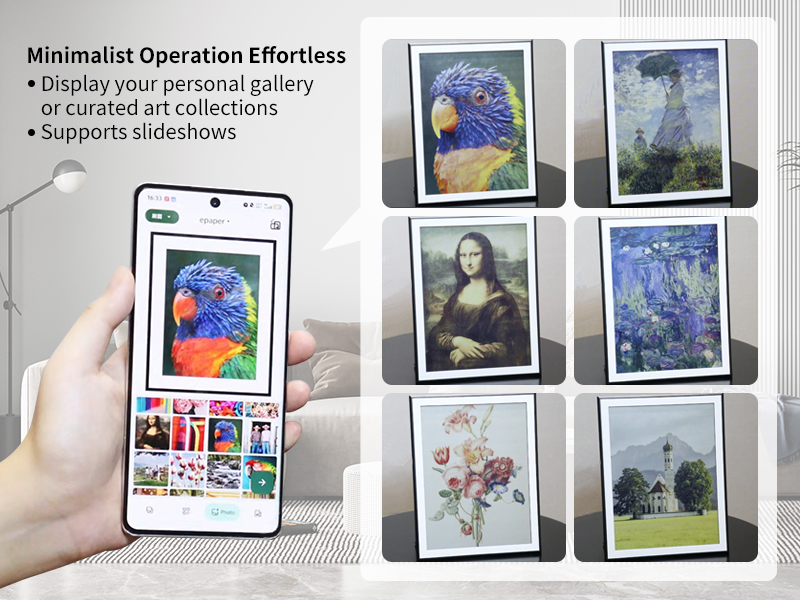
Despite the layout flexibility offered by dot-matrix ePaper displays, their overall visual performance still depends on the underlying technology—where Electrophoretic display remains the most widely adopted solution for reliable, large-format applications. As a professional e-ink display manufacturer, SEEKINK develops and delivers display solutions that fully leverage Electrophoretic ePaper technologies. SEEKINK’s S133E6-F0 E Ink Photo Frame demonstrates how mature Spectra 6 ePaper technology, combined with intelligent design, can deliver sustainable, next-generation display solutions.
