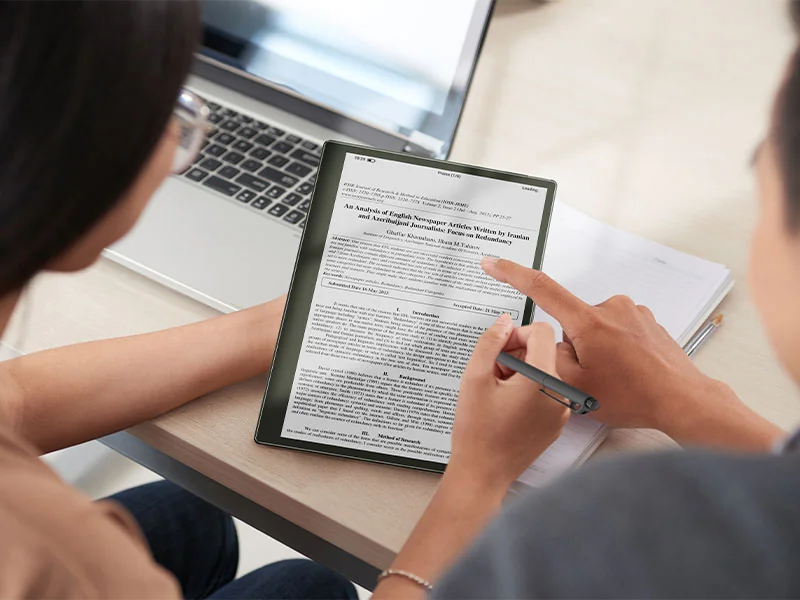
As digital transformation reshapes global education systems, smart education has become a core strategy for improving teaching quality, learning efficiency, and educational equity. In this transition, electronic paper (ePaper) is emerging as a critical enabling technology, particularly in scenarios that require long-term use, handwriting input, and eye-friendly reading. By combining digital connectivity with paper-like visual characteristics, ePaper is increasingly recognized as a foundational component of next-generation education infrastructure.
Key Application of ePaper in Smart Education
The application of ePaper in smart education mainly falls into two categories: school-oriented ePaper homework notebook systems and consumer-oriented educational practice tablets. Among these, the ePaper homework notebook system designed for schools represents the most structured and system-level application.
An ePaper homework notebook system typically consists of two core components: an ePaper-based intelligent learning terminal and a cloud-based education platform. The terminal replaces conventional LCD displays with electronic paper as the display unit and is built on an Android operating system. It supports handwriting input and connects to the cloud platform through Wi-Fi, 4G, or 5G networks. In practice, current ePaper homework notebooks are developed using ePaper handwriting device hardware as the base, with customized Android applications designed exclusively for student assignments. The system is packaged as a dedicated learning device, rather than a general-purpose tablet, ensuring focused and controlled usage.
Cloud Platforms and Data-Driven Learning
The cloud platform plays a central role in the smart education ecosystem. Its core functions usually include assignment question banks, paper generation, task distribution, and intelligent grading. Beyond these basic capabilities, the platform can analyze daily homework data to generate AI-driven insights.
By continuously collecting and analyzing student homework data, the system can build multi-dimensional learning profiles for individual students. These profiles provide schools, teachers, parents, and education authorities with data-driven reports from different perspectives, supporting instructional decision-making and education management.
Why ePaper Is a Rigid Demand in Smart Education
ePaper is increasingly considered a rigid demand in smart education, rather than an optional technology. Under the framework of Education Informatization 2.0, digital technologies are expected to comprehensively promote education modernization and support the transition toward intelligent education systems. A critical foundation of this process is the establishment of continuous student knowledge profiles, which serve as the basis for personalized learning.
Traditional paper-based homework and periodic exams create fragmented and qualitative learning records. They lack continuity and are difficult to analyze systematically. In contrast, daily homework data generated through ePaper-based digital assignments produces continuous, quantifiable, and structured learning records, enabling the construction of detailed student knowledge maps.
At the same time, long-term use of LCD-based learning devices raises concerns about eye strain and vision health, particularly for K12 students. This directly conflicts with national policies promoting youth eyesight protection. ePaper, as a non-emissive display technology, does not produce backlight glare and closely resembles printed paper, making it far more suitable for extended reading and writing tasks. If digital homework devices are essential data collection tools in smart education, then using ePaper as the display medium becomes a practical necessity rather than a preference.
Environmental and Sustainability Benefits
Beyond learning outcomes and health considerations, ePaper also delivers significant environmental value in education. Traditional K12 education consumes massive amounts of paper for daily exercises, homework, and exam materials. By digitizing these processes through ePaper homework notebooks, paper consumption can be substantially reduced.
According to modeling estimates based on a student population of approximately 180 million, widespread adoption of ePaper homework systems could reduce carbon emissions by more than 2 million tons of CO₂ equivalent. This aligns closely with sustainability goals and reinforces the role of smart education in supporting green development initiatives.
Reducing Teacher Workload and Enabling Personalized Teaching
From a teaching perspective, ePaper homework systems significantly reduce the workload associated with assignment grading. Objective questions can be graded automatically by the system, while subjective responses are digitally archived for review. Teachers can accurately track homework volume, completion time, and learning progress.
By analyzing individual student profiles, the system can identify specific knowledge gaps and support personalized assignment distribution. This data-driven approach provides strong support for differentiated instruction and enables true teaching according to individual aptitude, improving both efficiency and learning outcomes.
Why ePaper Fits Education Better Than LCD Devices
Educational learning scenarios are characterized by long usage duration, high handwriting frequency, and static or semi-static content. These conditions align perfectly with the strengths of ePaper technology. Unlike LCD screens, which are optimized for multimedia consumption, ePaper excels in focused learning environments where readability, comfort, and endurance are more important than animation or video playback.
By eliminating unnecessary visual stimulation and reducing energy consumption, ePaper-based learning devices create a calmer, more sustainable digital learning environment.
The Future Role of ePaper in Smart Education
As education systems continue to integrate digital tools, ePaper is expected to become a standard display technology for learning terminals, homework systems, and educational practice devices. Its compatibility with cloud platforms, AI analytics, and education data systems ensures long-term scalability and relevance.
With continuous improvements in performance, handwriting experience, and system integration, ePaper will play an increasingly central role in building intelligent, healthy, and sustainable education ecosystems.
SEEKINK and Its ePaper Education Solutions
SEEKINK is a global provider of electronic paper display solutions, focusing on the development of ePaper products for education. The H103NPL E-ink Tablet, designed for educational learning and handwriting scenarios. Built around an eye-friendly ePaper display, it supports digital writing, wireless connectivity, and long-term use without visual fatigue. With the e-ink tablet, SEEKINK helps schools and educational institutions advance toward data-driven, student-centered smart education while maintaining a strong commitment to eye health and sustainability.
