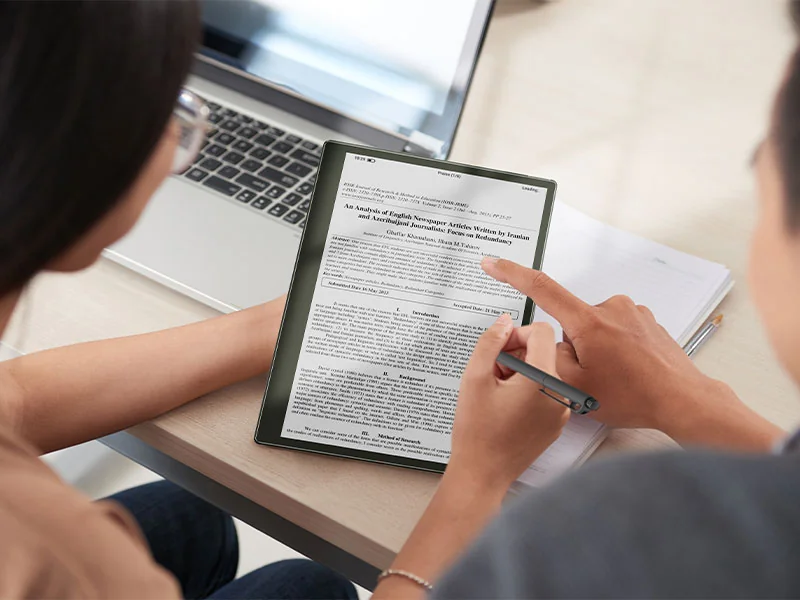
The ePaper market has undergone remarkable changes in recent years, with significant advancements in handwriting technology. From early electromagnetic solutions to the integration of capacitive touch technologies, the industry is evolving quickly. As demand for ePaper notebooks and digital note-taking devices grows, the need for precision, efficiency, and affordability is more critical than ever. SEEKINK, a pioneer in ePaper innovations, is embracing both electromagnetic and capacitive touch technologies, offering a hybrid handwriting solution that promises to revolutionize the industry. In this article, we will explore how handwriting technologies have evolved, how hybrid solutions are shaping the market, and how SEEKINK is pushing the boundaries of ePaper devices.
The Role of Electromagnetic Handwriting in ePaper
Before 2024, electromagnetic handwriting was the dominant technology used in ePaper notebooks. This technology involves a pen and a magnetic field to register movements on the display. Unlike capacitive touch solutions, which rely on the human body’s electrical conductivity, electromagnetic pens use precision and offer exceptional accuracy for writing, drawing, and sketching.
One of the main advantages of electromagnetic handwriting is its high resolution and the ability to detect 4096 levels of pressure sensitivity. This allows for a truly natural writing experience, akin to pen and paper. Furthermore, electromagnetic pens do not require batteries or complex wiring, making them lightweight and cost-effective. As a result, ePaper notebooks designed for handwriting tend to rely on electromagnetic pens for accurate input.
The Advantages and Improvements of Capacitive Touch Technology
Although electromagnetic handwriting has long been preferred for ePaper devices, the rise of capacitive touch technology has introduced significant improvements in handwriting input for ePaper. Capacitive touch is most commonly used in smartphones, tablets, and other touchscreen devices. However, recent advancements have made capacitive pens a viable alternative for ePaper notebooks.
Capacitive pens require batteries and feature a more complex design than their electromagnetic counterparts. However, their performance and data transmission have significantly improved in recent years. Manufacturers have worked on optimizing transmission protocols to minimize data loss and improve handwriting accuracy. As a result, capacitive pens have become a serious contender in the ePaper market.
In 2024, reMarkable, a leading player in the ePaper industry, fully adopted capacitive handwriting technology in its ePaper tablet. This move reflects the growing market acceptance of capacitive pens in the ePaper sector.
The Emergence of Hybrid Handwriting Technology
With the adoption of Metal Mesh capacitive touch technology in more ePaper devices, the idea of combining electromagnetic and capacitive technologies into a single device has emerged. This innovation is often referred to as the electromagnetic-capacitive hybrid solution, and it is expected to redefine the ePaper user experience.
The electromagnetic-capacitive hybrid solution works by merging two types of grids—the electromagnetic grid and the capacitive touch grid—onto a single, thin film. This integration allows ePaper devices to leverage the precision of electromagnetic pens and the touchscreen functionality of capacitive technology, all within one device. The ability to use a single-chip solution that combines both technologies will result in lower production costs, a simpler design, and enhanced performance. It is expected to revolutionize ePaper devices, providing users with the best of both worlds: precise handwriting and efficient touch interaction.
The Role of Frontlight Technology in ePaper Displays
In addition to advancements in handwriting technology, another significant development in ePaper is the integration of frontlight technology. Unlike traditional LCD screens, ePaper does not emit light but instead relies on ambient light for imaging. This makes reading in low-light environments challenging.
To solve this issue, frontlight technology has been incorporated into ePaper devices. A frontlight system uses a transparent light guide plate with micron-level design patterns that ensure even distribution of light across the screen. This allows users to read ePaper displays in low-light environments without significantly increasing power consumption. This energy-efficient lighting solution is crucial for ePaper devices, which are designed to be low-power and suitable for long-term use.
SEEKINK: Innovating with Hybrid Handwriting Technology
As a pioneer in the ePaper industry, SEEKINK has been at the forefront of adopting hybrid handwriting technologies in its ePaper devices. The H103NPL e-ink tablet natural writing and drawing capabilities with Wacom 4096-level pressure sensitivity. SEEKINK is creating ePaper notebooks that deliver unparalleled precision and versatility.
Through ongoing enhancements to screen quality and pioneering advancements in product development, SEEKINK is positioning e-paper technology at the heart of tomorrow’s consumer electronics. From e-readers and wearables to color-adaptive fashion, SEEKINK’s forward-thinking innovations are reshaping human-technology interaction—creating experiences that are more sustainable, efficient, and responsive.
