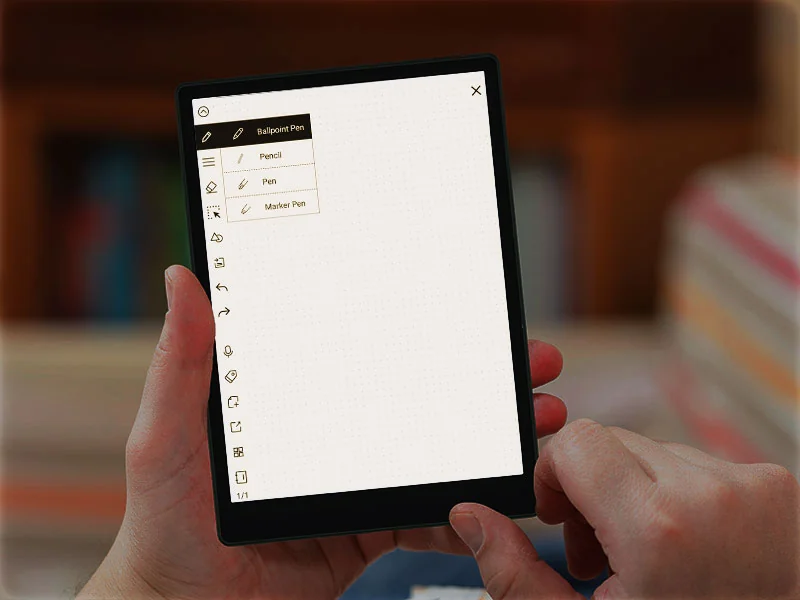
E-paper technology has revolutionized the way we interact with displays, offering a paper-like reading experience with the added advantages of low power consumption and flexibility. Key to its usability and performance are the touch and surface technologies that drive user interaction and enhance visual clarity. In this article, we will explore the importance of touch technologies like ITO (Indium Tin Oxide) and Metal Mesh, as well as surface treatment methods that improve durability and readability in e-paper devices. These technologies are particularly essential for devices like e-paper readers, where precise touch response and glare-free display are critical.
Touch Technology in E-Paper Devices
The touch technology used in e-paper devices significantly impacts user experience. There are two primary touch technologies for e-paper devices: ITO (Indium Tin Oxide) and Metal Mesh. Both technologies have their specific applications depending on the size of the display and the required touch performance.
ITO Touch Technology
ITO is a well-established technology for touchscreens and is commonly used in small- to medium-sized devices, such as e-readers. The primary advantage of ITO is its cost-effectiveness, especially for smaller screens. It offers an acceptable touch experience for e-paper devices with a simple touch input, making it a popular choice for e-paper books and tablets under 10 inches. Since ITO provides reliable performance at a lower cost, it remains a common solution in the e-paper industry for devices where touch sensitivity does not need to be overly advanced.
Metal Mesh Technology
While ITO works well for smaller devices, Metal Mesh has become the go-to touch technology for larger e-paper displays, especially those over 10 inches. Larger screens require more robust performance, and Metal Mesh offers several benefits over ITO. As the size of the display increases, ITO’s impedance becomes higher, affecting the performance of the touch functionality. On the other hand, Metal Mesh allows for better conductivity and touch accuracy, making it suitable for larger devices such as e-paper tablets and e-notebooks.
Metal Mesh technology is further divided into two types: Additive and Subtractive processes. The Subtractive process, using photolithography, was the first method to be commercialized and is widely used in today’s market. With a resolution precision of up to 3 microns, Metal Mesh technology provides high-quality touch sensitivity, ideal for larger e-paper screens.
Surface Treatment Technology
The surface treatment of e-paper displays is equally crucial in improving the display quality and user experience. Unlike traditional displays that rely on backlighting, e-paper displays depend on ambient light for visibility. Therefore, ensuring the surface is optimized for reflection and glare prevention is key.
Anti-Glare (AG) Coating
One of the most important surface treatments for e-paper displays is the Anti-Glare (AG) coating, which reduces reflections and prevents glare caused by ambient light. Since e-paper displays rely on light reflection to show content, a glare-free surface ensures the screen remains legible under various lighting conditions. This is especially important in outdoor environments, where sunlight can otherwise distort the visibility of the text.
In addition to enhancing visibility, the AG coating also contributes to a better reading experience by minimizing distractions such as fingerprints and dirt, which could otherwise degrade the clarity of the display. By ensuring that the surface remains clean and readable, this treatment significantly enhances the longevity and usability of e-paper devices.
Surface Coating Methods
For e-paper devices, glass covers are commonly used, and they undergo several surface treatments to improve both durability and performance. These treatments include methods like etching, electroplating, and spraying. Each of these techniques adds specific properties, such as enhanced scratch resistance or better clarity. Additionally, acrylic covers are sometimes used in place of glass due to their simpler surface treatment processes.
SEEKINK’s Advanced E-Paper Technology
At SEEKINK, the focus on cutting-edge e-paper technology ensures that our products provide an optimal user experience through superior touch and surface treatments. For instance, the H82EPL 8.2-inch E-Paper Reader integrates these advanced touch and surface technologies to provide a highly responsive and glare-free display. Whether you’re using it for reading, note-taking, or other tasks, the H82EPL delivers a superior, paper-like experience with enhanced touch sensitivity and a highly readable screen in all environments.
