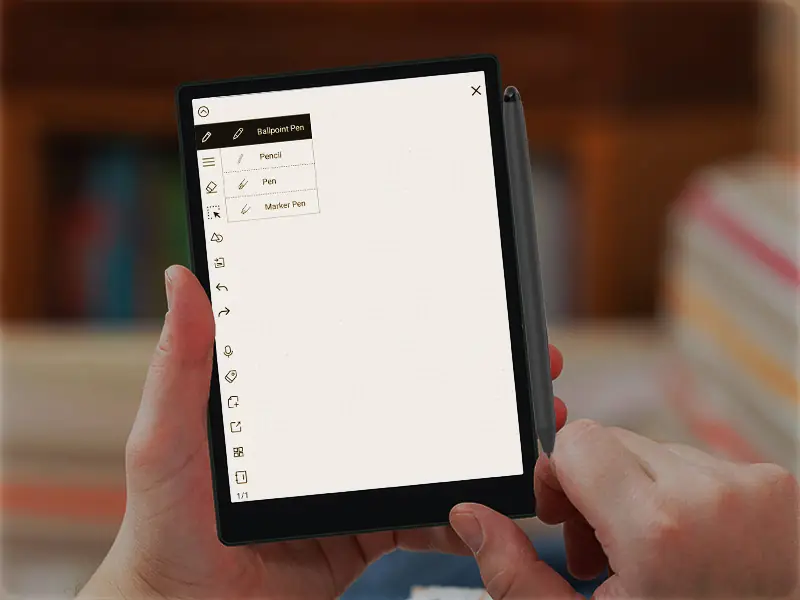
Handwriting has always been one of the most natural and efficient ways for humans to record, think, and create. As electronic paper (ePaper) devices move beyond pure reading into productivity and creativity, handwriting technology has become a core differentiator. Over the past decade, the evolution from single-mode electromagnetic input to increasingly mature capacitive handwriting—and now toward hybrid solutions—has reshaped the design logic of ePaper notepads and writing terminals.
Why Handwriting Is Central to ePaper Product Design
Unlike LCD or OLED tablets, ePaper devices emphasize long-duration use, visual comfort, and low power consumption. These characteristics make them especially well suited for writing, note-taking, and sketching. As a result, handwriting is not an optional feature in many ePaper products—it is a primary function that directly defines user experience.
This requirement has driven the industry to adopt handwriting technologies that deliver high precision, low latency, and strong reliability, while keeping system power consumption and device cost under control.
Electromagnetic Handwriting: The Long-Standing Mainstream
Before 2024, electromagnetic (EMR) handwriting technology dominated ePaper handwriting devices. Unlike capacitive handwriting—which is derived from finger touch—electromagnetic handwriting was originally developed for professional digital drawing tablets and dedicated writing devices.
Electromagnetic handwriting offers several decisive advantages. The pen tip can be extremely fine, enabling accurate stroke rendering. Pressure sensitivity can reach up to 4,096 levels, allowing users to vary line thickness naturally. Most importantly, the pen does not require a built-in battery or active circuitry, which significantly reduces pen cost and improves reliability.
Because of these strengths, electromagnetic handwriting has been widely adopted in ePaper notepads and writing-focused devices, where writing quality is more important than multimedia interaction. For many years, it set the benchmark for what “good handwriting” meant in the ePaper category.
Why Capacitive Handwriting Was Initially Overlooked
In contrast, capacitive pen handwriting was long considered unsuitable for ePaper. Traditional capacitive pens require internal batteries, complex circuitry, and active communication with the device. This makes them more expensive and less robust than electromagnetic pens.
In early implementations, capacitive handwriting also suffered from lower precision and unstable performance, especially on ePaper displays. Because ePaper refresh rates are slower than those of LCDs, handwriting data transmission could experience interference, resulting in dropped points, broken strokes, or visible latency. For a long time, these issues prevented capacitive handwriting from gaining traction in the ePaper ecosystem.
Recent Breakthroughs in Capacitive Handwriting Performance
In recent years, however, capacitive handwriting technology has undergone significant improvements. Optimized communication protocols, better noise suppression, and refined data sampling strategies have greatly reduced handwriting data loss caused by ePaper display refresh behavior.
As a result, capacitive handwriting performance, stability, and visual consistency have improved dramatically. These advances have led leading ePaper notepad brands in mainland China to begin actively adopting capacitive handwriting solutions. This industry shift signals that capacitive handwriting is no longer a secondary option, but a technology with serious long-term potential in ePaper devices.
The Role of Metal Mesh Touch Technology
The rise of capacitive handwriting in ePaper devices is closely linked to the adoption of Metal Mesh capacitive touch technology. Compared with traditional ITO touch layers, Metal Mesh offers lower resistance, better scalability for larger screens, and improved signal stability.
As Metal Mesh became more widely used in ePaper notepads—especially in devices above 10 inches—it created the technical foundation needed to support higher-quality capacitive handwriting. The improved electrical performance of Metal Mesh reduces latency and enhances pen tracking accuracy, making capacitive handwriting far more viable than in earlier generations.
Toward Hybrid Electromagnetic + Capacitive Solutions
As both electromagnetic and capacitive handwriting technologies matured, the industry began exploring ways to combine their strengths rather than treating them as mutually exclusive. This idea gained formal attention at the Second ePaper Innovation Application Conference, where a hybrid electromagnetic–capacitive handwriting concept was publicly introduced.
The theoretical basis for this hybrid approach is compelling. From a structural perspective, an electromagnetic handwriting board is itself a form of metal grid. With Metal Mesh manufacturing processes, it becomes technically feasible to design both electromagnetic and capacitive sensing grids on a single thin film, enabling dual-mode handwriting input.
At the same time, integrating the capacitive touch controller and electromagnetic handwriting controller into a single chip-level solution opens the door to a major shift in system architecture. This kind of integration has the potential to significantly reduce component count, simplify system design, and lower overall product cost.
Why Hybrid Handwriting Matters for the Future
Hybrid handwriting solutions represent an important step forward in the evolution of ePaper devices. By combining high-precision passive pen input for natural writing with active capacitive pen or finger input for navigation and interaction, ePaper notepads can support a wider range of use cases without compromising their core handwriting experience. This dual-input flexibility enhances usability for tasks such as document browsing, interface control, and annotation, while preserving the paper-like feel that users expect from ePaper writing devices.
From an industry perspective, deeper chip-level integration of handwriting technologies has the potential to reshape the cost structure and scalability of ePaper products. Consolidating handwriting functions at the silicon level can reduce bill-of-materials complexity, simplify system design, and improve manufacturing efficiency. Over time, these benefits may accelerate the adoption of ePaper notepads across education, enterprise, and professional markets, where reliability, cost control, and long battery life are critical considerations.
Within this evolving landscape, SEEKINK brings advanced handwriting to practical ePaper devices. With advances in handwriting technology and system-level integration, SEEKINK designs products that strike a careful balance between writing accuracy, device reliability, and power efficiency. A representative example is the H82NPL 8.2-inch ePaper Notepad, developed to support comfortable, long-duration handwriting and note-taking within a compact form factor. Through thoughtful adoption of emerging handwriting solutions, SEEKINK continues to refine the real-world usability and versatility of ePaper writing devices.
