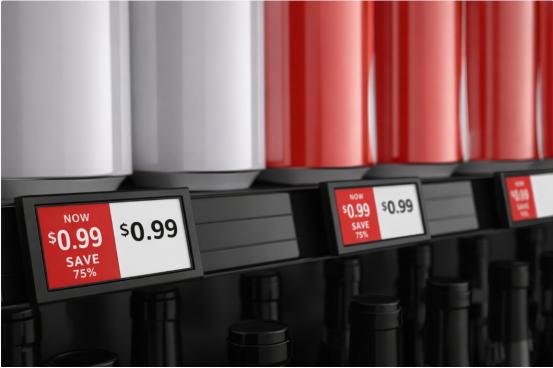
As sustainability becomes a central requirement in global trade and digital infrastructure, carbon footprint quantification and carbon neutrality are no longer abstract concepts—they are measurable, reportable, and increasingly mandatory. In the retail industry, electronic shelf labels (ESL) represent one of the most widely deployed Internet of Things (IoT) devices, making their environmental impact particularly significant. Against this backdrop, the release of the world’s first lifecycle carbon footprint assessment for ESL products marks an important milestone for both the electronic paper industry and low-carbon retail transformation.
Why Lifecycle Carbon Footprint Standards Matter
A product’s carbon footprint reflects the total greenhouse gas emissions generated across its entire lifecycle, rather than focusing solely on manufacturing. For ESL products, this includes emissions from raw material extraction, component production, assembly, transportation, deployment, daily operation, and eventual disposal or recycling.
To ensure scientific rigor and international comparability, carbon footprint assessments must follow recognized standards. In this case, the evaluation was conducted in accordance with ISO 14067:2018, which defines the requirements and guidelines for quantifying product carbon footprints, as well as PAS 2050:2011, a widely adopted specification for assessing lifecycle greenhouse gas emissions of products and services.
For many years, despite the large-scale adoption of ESL systems in global retail, reliable and standardized carbon footprint data was essentially absent. This gap limited the ability of retailers and solution providers to incorporate ESL deployments into formal ESG reporting frameworks.
The First Carbon Footprint Assessment for ESL Products
A breakthrough came when a company announced that it had commissioned SGS, a globally recognized third-party testing, inspection, and certification organization, to complete carbon footprint verification reports for four ESL products. This initiative resulted in the first lifecycle carbon footprint assessment report for electronic shelf labels in the global retail industry.
The assessment followed both ISO 14067:2018 and PAS 2050:2011, and adopted a full lifecycle assessment (LCA) methodology. All lifecycle stages were included:
Raw material sourcing
Manufacturing and assembly
Distribution and retail deployment
Consumer and operational use
End-of-life disposal or recycling
This comprehensive approach ensures that the reported values reflect the true environmental impact of ESL products, rather than partial or stage-specific emissions.
Measured Carbon Footprint Results Across ESL Sizes
The assessment covered four commonly used ESL sizes—1.6-inch, 2.2-inch, 2.6-inch, and 4.2-inch—representing typical retail deployment scenarios. The verified lifecycle carbon footprints were:
1.6-inch ESL: 0.1398 kg CO₂e
2.2-inch ESL: 0.2339 kg CO₂e
2.6-inch ESL: 0.2587 kg CO₂e
4.2-inch ESL: 0.5740 kg CO₂e
These figures clearly demonstrate the low-carbon nature of ePaper-based ESL products, even when evaluated across their full lifecycle. The values are notably low when compared with many other digital display or IoT devices, largely due to the ultra-low power characteristics of electronic paper technology.
Carbon Neutrality at a Negligible Cost
Perhaps the most compelling insight from the report is the economic feasibility of carbon neutrality. Using the reference price from China’s national carbon trading market—52.7 RMB per ton of CO₂, based on the first official transaction—the cost required to offset the lifecycle emissions of each ESL unit is extremely small.
The calculated carbon offset costs per unit are approximately:
1.6-inch ESL: 0.0074 RMB
2.2-inch ESL: 0.0123 RMB
2.6-inch ESL: 0.0137 RMB
4.2-inch ESL: 0.0303 RMB
By adding only a few cents—or even fractions of a cent—per device, each ESL product can achieve full lifecycle carbon neutrality. This finding underscores a key advantage of ePaper technology: carbon neutrality is not only technically achievable, but also economically trivial at the device level.
Why ESL Is Inherently Low-Carbon
The carbon efficiency of ESL products stems from the fundamental properties of electronic paper displays. ePaper consumes power only when content changes and requires no energy to maintain static images. In retail environments, prices and product information change relatively infrequently, allowing ESL devices to operate for years on a single battery.
In contrast, LCD- or LED-based displays consume power continuously, generating emissions throughout their operational lifetime. Over multi-year deployments, this difference results in dramatically higher lifecycle emissions for emissive display technologies.
Because the LCA includes both production and usage phases, the assessment captures this long-term advantage, reinforcing ESL’s position as a low-carbon digital infrastructure component for smart retail and beyond.
Implications for ESG and Global Retail
With stricter environmental regulations emerging—particularly in Europe—and ESG disclosure becoming standard practice for international supply chains, verified carbon footprint data is rapidly becoming a strategic asset. Retailers deploying ESL systems with certified lifecycle data can more accurately quantify emission reductions and strengthen their ESG reporting.
Moreover, the ability to reach carbon neutrality at minimal cost provides a practical pathway for aligning digital transformation with sustainability goals, without sacrificing operational efficiency or profitability.
Beyond ESL: A Signal for the ePaper Industry
This first ESL carbon footprint assessment sets an important precedent for the broader ePaper ecosystem. It demonstrates that low-power digital displays can be systematically evaluated, transparently reported, and easily neutralized in carbon terms.
The methodology and results can be extended to other ePaper applications, including digital signage, healthcare information displays, and large-format commercial ePaper solutions. As carbon transparency becomes a procurement requirement, ePaper’s measurable environmental advantages are likely to gain increasing importance.
SEEKINK and Its Low-Carbon ePaper Display Solutions
SEEKINK delivers practical ePaper display solutions with a focus on our shelf-level strategic brand partners’s B2B business based on our ePaper display module (EPD module) manufacturing. By leveraging the ultra-low power characteristics of ePaper, SEEKINK helps build a more sustainable future for smart retail and public environments.
