Over the past 15+ years, the electronic paper (ePaper) industry has experienced dramatic cycles of rapid expansion, sharp contraction, structural recovery, and sustained high-speed growth. From the early success of eReaders to today’s diversified applications across retail, education, transportation, and digital signage, ePaper has evolved into a resilient and fast-growing display ecosystem. Understanding this journey helps explain why ePaper continues to gain momentum despite intense competition from conventional display technologies.
The eReader Boom and the First Golden Age (2008–2011)
The modern ePaper industry entered its first explosive growth phase following Amazon’s launch of the eReader in 2007. The product’s success validated ePaper as a commercially viable display technology and triggered a global surge in demand for eReaders. Between 2009 and 2011, the industry recorded extraordinary compound annual growth rates of 312%, 172%, and 129%, respectively.
By 2011, global eReader shipments reached a historical peak of over 23 million units, marking the high point of the industry’s first growth cycle. During this period, ePaper was almost synonymous with digital reading, and the industry’s fortunes were closely tied to a single application category.
Market Shock and Industry Contraction (2012–2014)
The launch of the iPad 2 in 2011 fundamentally reshaped the consumer electronics landscape. Tablets introduced color, multimedia, and app ecosystems that diverted consumer attention away from single-purpose eReaders. At the same time, within China’s ePaper ecosystem, aggressive pricing strategies driven by local online literature platforms pushed hardware prices below cost.
As a result, dozens of Chinese ePaper ODM manufacturers exited the market, severely damaging the industry’s supply-chain ecosystem. Between 2012 and 2014, global eReader shipments declined year after year, falling below 10 million units by 2014. During this period, Amazon largely sustained the ePaper industry on its own, while overall market confidence weakened significantly.
A Turning Point: ESL Emerges as a Growth Engine (2015–2016)
The years 2015 and 2016 marked a decisive turning point. While the eReader market began to stabilize and rebound from its lowest point, a new application category—electronic shelf labels (ESL)—started to scale rapidly.
After several years of market incubation, ESL shipments exceeded 10 million units in 2015 and surpassed 20 million units in 2016. By 2017, ESL shipments were approaching 30 million units, injecting new momentum into the ePaper industry. This shift reduced the industry’s dependence on consumer reading devices and laid the foundation for broader industrial adoption.
Industry Recovery and Acceleration (2017–2018)
In 2017, global eReader shipments recorded their first year of positive growth since 2012. At the same time, ESL deployments accelerated worldwide. By 2018, global ESL shipments exceeded 50 million units, and total ePaper display module shipments grew 76% year-on-year.
This period marked the industry’s full recovery. More importantly, it confirmed that ePaper’s future extended far beyond reading. Retail digitalization, IoT integration, and low-power display requirements positioned ePaper as a strategic technology for smart infrastructure.
Entering the High-Growth Era (2019–2021)
From 2019 onward, the ePaper industry entered a sustained high-growth phase. Global shipments exceeded 90 million units in 2019. During the COVID-19 pandemic in 2020, while many electronics markets struggled, demand for ePaper continued to rise due to its role in retail automation, logistics, and contactless information delivery.
By 2020, annual shipments surpassed 130 million units, roughly double the 2018 level and nearly ten times the 2014 volume. In 2021, ESL demand surged further, outpacing upstream supply capacity. ePaper film manufacturers and module suppliers rapidly expanded production, driving ecosystem-wide growth. Global shipments reached nearly 180 million units, setting another historical record.
Between 2017 and 2021, the industry achieved a compound annual growth rate exceeding 48%, firmly establishing ePaper as a dominant technology within its niche markets.
Scale Expansion and Technology Transition (2022–2023)
In 2022, global ePaper device shipments exceeded 280 million units, representing a 58% year-on-year increase. However, 2023 brought new challenges. The global consumer electronics market weakened, and the ESL sector underwent a major technology transition from black-white-red (BWR) to black-white-red-yellow (BWRY) four-color displays.
This transition temporarily affected production efficiency and order fulfillment. Even so, total shipments still reached approximately 310 million units in 2023, achieving 11% growth and demonstrating the industry’s resilience.
Growth Consolidation and New Opportunities (2024)
By 2024, the four-color technology transition was largely completed, and the industry returned to stable delivery. Global shipments reached approximately 380 million units, up 22% year-on-year. Traditional segments such as eReaders and ESL continued steady growth, while ePaper notebooks—especially education-focused devices—emerged as a strong new growth driver.
At the same time, large-format color ePaper signage and innovative technologies such as Prism electrochromic ePaper expanded the industry’s future potential. According to ePaper Insight, cumulative global shipments surpassed 1.6 billion units by the end of 2024, confirming the industry’s long-term high-growth trajectory.
From Single Product to Full Ecosystem
Looking across these stages, the ePaper industry has transformed from a single-product market into a cross-industry, multi-application ecosystem. Today’s ePaper landscape spans consumer electronics, smart retail, education, transportation, industrial logistics, and digital signage. This diversification has significantly strengthened the industry’s stability and growth potential.
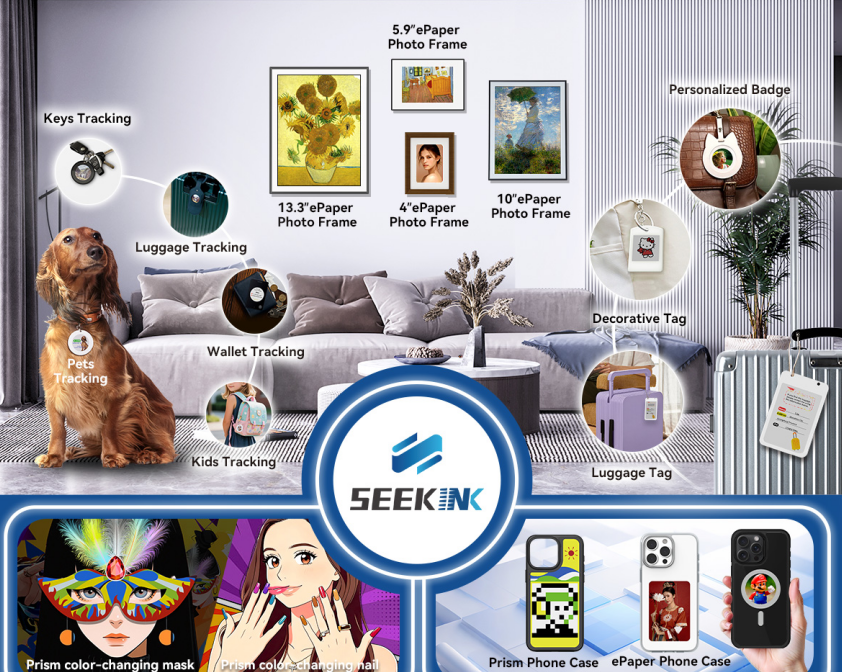
SEEKINK is an active participant in the evolving ePaper ecosystem, focusing on practical, user-oriented ePaper solutions for identification, information display, and professional environments. Looking ahead, SEEKINK remains committed to advancing the ePaper ecosystem through collaboration, continuous innovation, and a shared focus on sustainable, low-power digital infrastructure.
