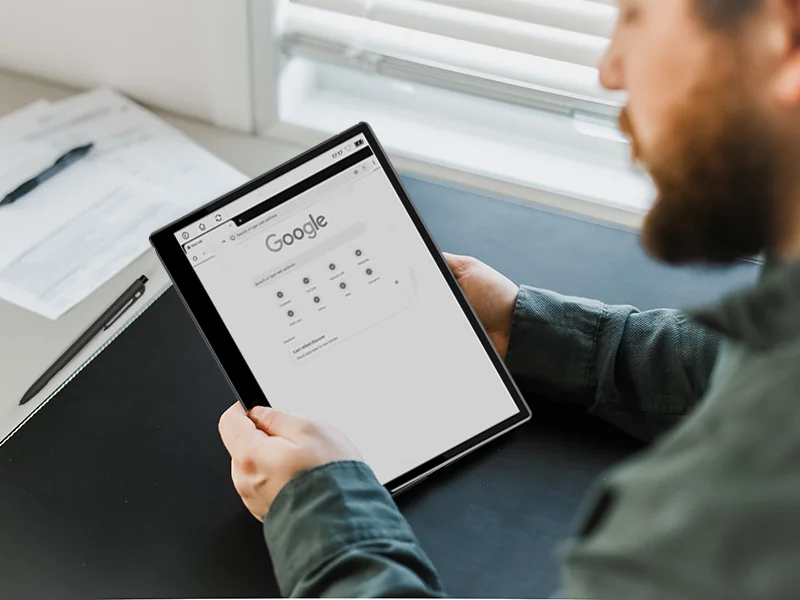
As electronic paper (ePaper) evolves from simple displays into interactive, high-resolution terminals, dedicated chips and touch technologies have become critical enablers. Unlike conventional LCD or OLED products, ePaper devices operate under very different constraints: ultra-low power consumption, temperature-dependent display behavior, reflective optics, and, in many cases, handwriting interaction. To meet these requirements, the ePaper industry has developed a specialized ecosystem of application-specific chips and optimized touch solutions that together define the user experience of modern ePaper products.
Specialized Chips in ePaper Systems
As a display category, ePaper requires multiple types of chips during product design and system integration. Based on their functional roles, these chips can generally be divided into main control chips and auxiliary or passive chips, many of which are specifically designed for ePaper applications rather than reused from general consumer electronics.
Taking an ePaper notepad as an example, this type of product typically uses electrophoretic microcapsule ePaper displays that feature high resolution, relatively fast refresh, 16 grayscale levels, and support for partial refresh. Such displays usually rely on a TTL parallel interface, which differs from the interfaces commonly used in small signage or label applications.
To drive these reading-class ePaper display modules, a dedicated timing controller (TCON) is required. Without this timing control logic, the display cannot be properly driven. In some system designs, the TCON is implemented as a separate external chip. In more integrated designs, the ePaper-specific TCON IP is embedded directly into the main processor, forming a single-chip system-on-chip (SoC) solution. This approach reduces component count, lowers power consumption, and simplifies board design—key advantages for compact and portable ePaper devices.
Power Management: A Unique Requirement for ePaper
High-resolution ePaper displays also impose unique requirements on power management. Unlike LCDs, ePaper displays require multiple high-voltage rails to move charged particles within the display layer. As a result, ePaper systems often require a dedicated power management IC (PMIC) capable of generating multiple adjustable voltages.
For typical reading-class ePaper displays, the PMIC must supply voltage groups such as ±15 V, ±20 V, and –5 to 0 V, all of which must be precisely controlled. The stability and efficiency of these voltage rails directly affect display quality, refresh behavior, and long-term reliability. This is why ePaper PMICs are usually purpose-built rather than repurposed from other display technologies.
Application-Specific Chips for Different ePaper Scenarios
Beyond reading devices, different ePaper applications have driven the development of customized chips optimized for specific use cases. For example, electronic shelf labels (ESL) could theoretically use standard Bluetooth chips. However, to further reduce power consumption and system cost, the industry has developed dedicated 2.4 GHz ePaper controller chips optimized for ESL communication patterns.
These specialized chips integrate wireless communication, display control, and power management in a single package, enabling battery-powered labels to operate for years without replacement. This level of optimization is difficult to achieve using general-purpose components, highlighting the importance of application-specific chip design in the ePaper ecosystem.
Touch Technologies in ePaper Devices
As ePaper devices become more interactive, touch technology has emerged as another critical component. In ePaper tablets and notepads, two main touch technologies are used: ITO (indium tin oxide) and Metal Mesh.
Before 2020, most ePaper devices relied on ITO touch layers. For small and medium-sized eReaders, ITO remains cost-effective and provides acceptable finger-touch performance. However, as screen sizes increase, ITO faces two major challenges. First, its electrical resistance rises with size, which negatively affects responsiveness. Second, as display size increases, the cost advantage of ITO diminishes.
As a result, around the 10-inch size mark, the industry has largely shifted toward Metal Mesh touch technology. For ePaper notepads larger than 10 inches, Metal Mesh provides better electrical performance while offering a cost structure that is increasingly competitive with ITO.
Metal Mesh: Additive vs. Subtractive Processes
Metal Mesh touch technology itself can be divided into subtractive and additive manufacturing processes. The subtractive process, typically based on photolithography (“yellow light” processing), was commercialized earlier and is currently capable of achieving line widths of around 3 micrometers. This approach is mature and widely used.
The additive Metal Mesh process, often based on chemical plating, has advanced rapidly in recent years. Compared with subtractive methods, additive processing reduces material waste, offers stronger adhesion, simplifies process steps, and is generally more environmentally friendly. Technologically, additive Metal Mesh has already achieved line widths as fine as 2 micrometers, enabling high transparency and excellent touch sensitivity.
In today’s market, both Metal Mesh processes are used in large-format ePaper notepads, with the choice depending on cost targets, supply chain considerations, and product positioning.
The Synergy Between Chips and Touch Systems
Dedicated chips and touch technologies do not function independently. High-performance handwriting on ePaper requires tight coordination between the main processor, touch controller, display driver, and power management system. Latency, sampling rate, and refresh synchronization all influence the perceived writing experience.
Optimized integration allows ePaper devices to deliver smooth pen input, accurate stroke rendering, and low power consumption simultaneously—capabilities that were difficult to achieve in earlier generations of ePaper hardware.
Why These Technologies Matter for the ePaper Market
The advancement of specialized ePaper driver chips and touch technologies has played a critical role in moving ePaper beyond its early association with static reading devices. These core technologies enable faster response times, more precise input, and improved system efficiency, making it possible to support new product categories such as digital notebooks, educational tools, and professional writing devices—while preserving the defining strengths of ePaper, including eye comfort, long battery life, and a paper-like user experience.
As the ePaper ecosystem continues to mature, ongoing optimization at both the chip and touch layers is expected to further enhance handwriting responsiveness, lower system costs, and unlock new interaction models. Together, these developments will expand the functional scope of ePaper products and accelerate their adoption across both consumer and professional markets.
Within this evolving landscape, SEEKINK focuses on transforming mature ePaper technologies into practical, user-centric devices designed for real-world use. By carefully integrating dedicated ePaper driver chips, optimized power management architectures, and application-appropriate touch solutions, SEEKINK delivers reliable products tailored to reading and writing scenarios. H103NPL E Ink Android Tablet is engineered to balance smooth handwriting performance, clear display quality, and ultra-low power consumption. Through thoughtful system-level design and technology integration, SEEKINK continues to bring advanced, comfortable, and energy-efficient ePaper experiences into everyday workflows.
