In electrophoretic electronic paper (ePaper) display systems, image quality and stability depend not only on the electronic ink itself, but also on precise electrical control. At the center of this control mechanism is the driver chip, a critical component responsible for translating digital image data into the electric fields that move charged ink particles. Although ePaper driver chips share manufacturing principles with LCD driver chips, their timing logic, interfaces, and driving waveforms are specifically customized for the unique characteristics of electrophoretic displays.
Why ePaper Uses LCD-Like Driver Chip Technology
To drive the TFT (Thin-Film Transistor) backplane, electrophoretic ePaper display modules use driver chips manufactured with processes similar to those used for LCD displays. These chips are typically produced using high-voltage semiconductor processes and are bonded directly onto the TFT backplane.
Structurally, the driver chip connects to the source lines (Source) and gate lines (Gate) of the TFT array. This architecture is consistent with LCD panels. However, despite the similarity in hardware principles, ePaper driver chips operate under fundamentally different display logic, because electrophoretic displays do not require continuous refreshing or backlighting.
As a result, while the physical integration resembles LCD systems, the driving sequence, signal timing, and interface protocols are uniquely designed for ePaper.
From Digital Signal to Electric Field: The Driving Process
When an external controller sends display data to an ePaper module, the driver chip plays the role of signal translator and executor. It converts incoming interface timing signals into precise high and low voltages applied to individual pixel electrodes on the TFT backplane.
For each pixel:
The driver chip selects the appropriate gate line, enabling a specific row of pixels.
It applies voltage signals through the source lines corresponding to pixel columns.
These voltages create an electric field between the TFT backplane electrodes and the ITO (Indium Tin Oxide) conductive layer on the upper side of the electronic paper film.
This electric field acts on the charged ink particles inside the microcapsules, driving them to move in a controlled manner.
How Charged Particles Create Visible Images
Inside each microcapsule are positively charged black particles and negatively charged white particles, suspended in a transparent fluid. When the electric field is applied at a pixel level, particles respond according to their charge polarity:
Black particles move toward one electrode
White particles move toward the opposite electrode
Depending on which particles reach the top viewing surface, the pixel appears black, white, or a shade in between. Once the particles reach their target positions, they remain there without further power input, allowing the image to be retained with zero or near-zero energy consumption.
This pixel-by-pixel control enables ePaper displays to render text, graphics, and symbols with high stability, even when power is removed.
The Importance of Timing and Waveform Control
Unlike LCDs, where brightness is controlled continuously, electrophoretic ePaper relies heavily on time-based voltage control. The driver chip determines not only the voltage level but also the duration of voltage application, known as the pulse width.
For microcapsule-based electrophoretic ePaper, most displays are primarily black-and-white. However, by carefully controlling how long the voltage is applied to the particles, the system can achieve partial movement of black and white particles, resulting in intermediate shades of gray.
This technique enables grayscale rendering, smooth transitions between tones, and improved readability of images and text.
In practical applications, mainstream microcapsule ePaper displays typically support 16 grayscale levels, which is sufficient for text, diagrams, and basic graphics in information-display scenarios.
How Grayscale Is Generated in ePaper Displays
Grayscale generation in electrophoretic ePaper does not rely on color mixing or brightness modulation. Instead, it is achieved by time-sequence control:
When voltage is applied briefly, particles move only partially
When voltage is applied longer, particles move more completely
By precisely adjusting the pulse width of the driving voltage, the ratio of black to white particles visible at the surface changes. This controlled mixing produces stable gray tones that remain visible without continuous power.
Because grayscale is tied directly to waveform accuracy, the quality of the driver chip and its waveform algorithms plays a decisive role in overall display performance.
Why ePaper Driver Chips Are Custom-Designed
Although the underlying semiconductor processes are similar to those of LCD driver chips, ePaper drivers must be customized for electrophoretic behavior. Key differences include:
Specialized waveform libraries for particle motion
Optimized timing to reduce ghosting effects
Interfaces tailored for low refresh rates and static images
Support for ultra-low power operation
These customizations ensure that ePaper displays achieve high image stability, minimal artifacts, and long operational lifetimes, even in outdoor or unattended environments.
Reliability in Large-Format ePaper Applications
In large-format applications—such as ePaper signage, transportation displays, and public information systems—driver chip reliability becomes even more critical. Each pixel must respond consistently across wide temperature ranges and over long usage cycles.
Because images often remain unchanged for hours or days, driver systems must ensure uniform particle positioning across the entire display surface. Well-designed driver chips help maintain contrast consistency and prevent uneven aging of the display.
Why Electrophoretic ePaper Excels in Static Information Display
The driving principle described above explains why electrophoretic ePaper is ideally suited for static or semi-static content. Once the image is formed, no additional power is required to maintain it. This makes ePaper uniquely advantageous for applications where information updates are infrequent, but visibility must remain constant.
Typical use cases include:
Public transportation signage
Outdoor information boards
Smart city infrastructure
Battery-powered display systems
In these scenarios, driver efficiency directly translates into longer device lifespans and lower maintenance costs.
SEEKINK and Its Expertise in ePaper Display Systems
SEEKINK applies its expertise in electrophoretic driving control and display system integration across a range of application-oriented ePaper products. By optimizing the interaction between driver chips, waveform algorithms, and ePaper films, SEEKINK ensures stable image formation and long-term visual consistency—key requirements for applications where information remains visible for extended periods.
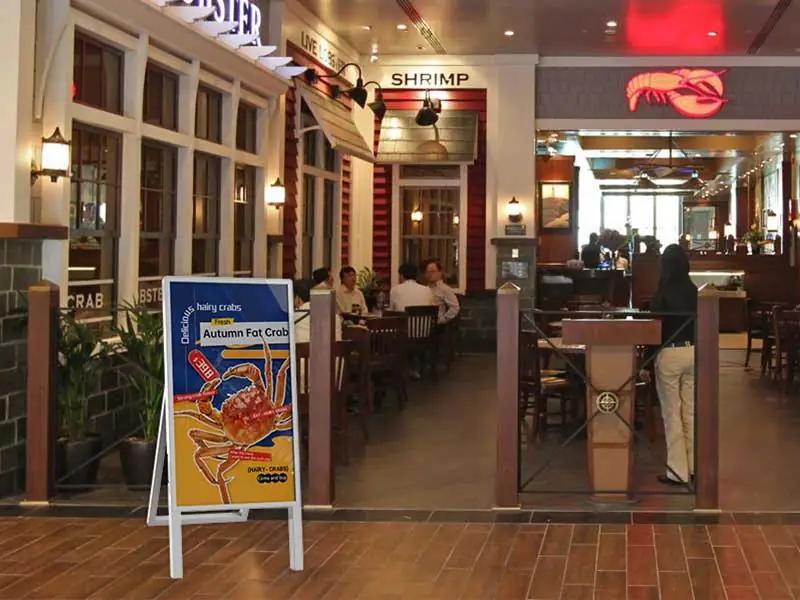
For example, E-ink Floor-standing Billboard, designed for commercial environments. Designed for always-on information delivery, it supports clear presentation of schedules, notices, promotions, and operational updates without the need for continuous power consumption. As a leader in e-ink display industry, SEEKINK demonstrates how ePaper technology delivers reliable, energy-efficient information display for real-world scenarios beyond transportation and electronic reading.
