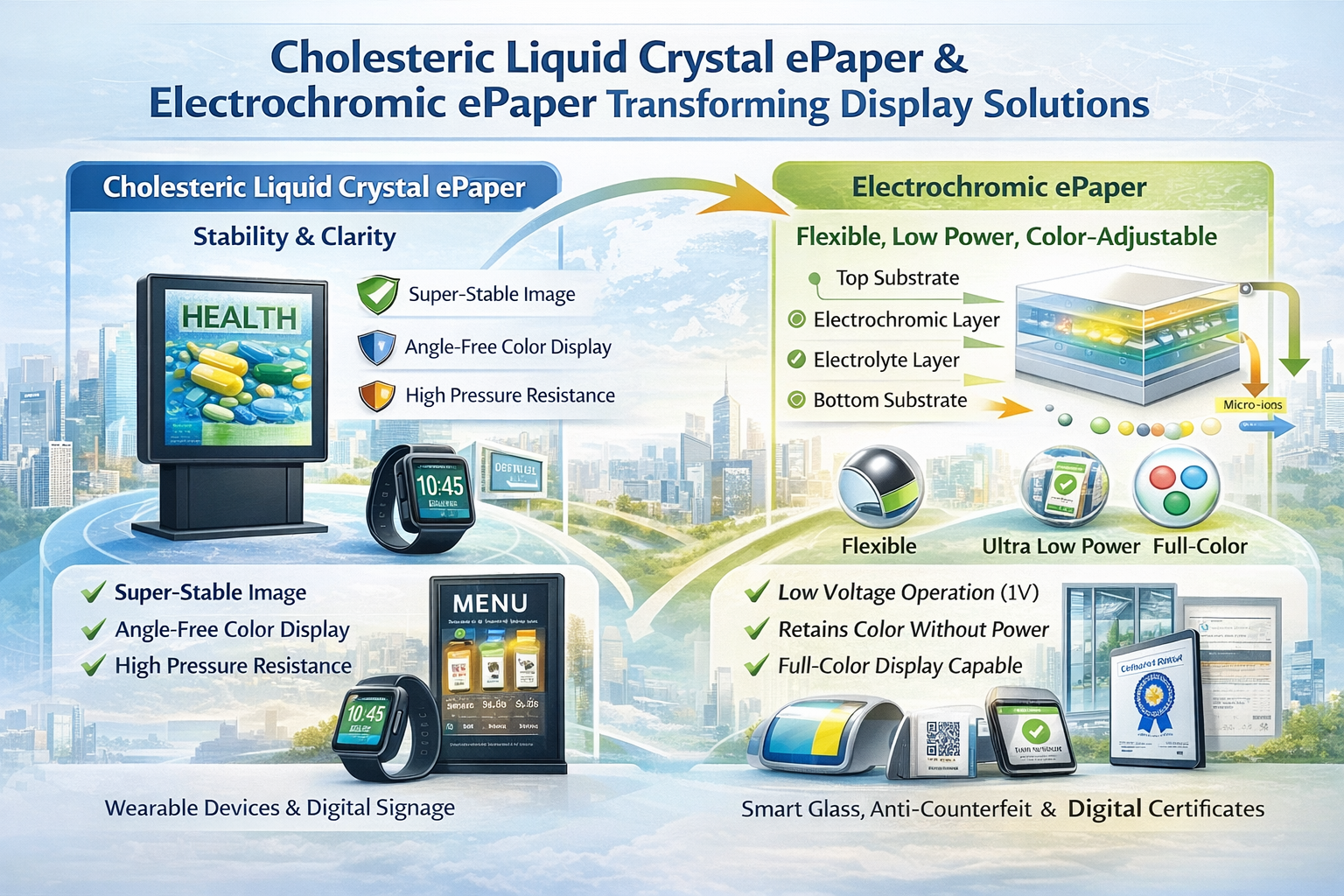
The rapid evolution of display technologies has brought about remarkable innovations, particularly in the field of ePaper technology. Among the most advanced solutions are Cholesteric Liquid Crystal ePaper and Electrochromic ePaper technologies, which offer significant advantages in terms of performance, flexibility, and energy efficiency. These technologies are not only revolutionizing digital displays but also setting new standards in various applications, from digital signage to smart glass.
Cholesteric Liquid Crystal ePaper: Stability and Clarity
Cholesteric Liquid Crystal (CLC) ePaper technology is known for its multistable properties, providing a unique solution to many issues seen in traditional liquid crystal displays (LCDs). One of the key challenges of conventional Cholesteric LCDs is color shift and poor pressure resistance, which often result in distorted visuals and limited durability.
However, the super-stable Cholesteric Liquid Crystal ePaper addresses these issues with a unique material system and manufacturing technique. Unlike standard Cholesteric LCDs that rely on the geometric alignment of liquid crystal domains, super-stable technology balances the system’s energy distribution across the crystal domains and interfaces. This optimization ensures the display remains highly stable, providing superior pressure resistance and eliminating angle-dependent color shift.
These features make Cholesteric Liquid Crystal ePaper an ideal choice for applications requiring durable, high-quality displays with excellent clarity and consistency, such as wearable devices and digital signage.
Electrochromic ePaper: Flexible, Low Power, and Color-Adjustable
Another groundbreaking ePaper technology is Electrochromic ePaper, which offers flexibility and low power consumption without compromising on performance. The technology consists of several layers: a top substrate, an electrochromic layer, an electrolyte layer, an electrode layer, and a bottom substrate.
The principle behind electrochromism is the reversible change in the material’s optical properties, such as reflectivity, transmissivity, and absorbance, when subjected to an electric field. As a low voltage (typically around 1V) is applied, micro-ions within the electrolyte layer move, triggering oxidation-reduction reactions in the electrochromic layer, leading to a color change. This color transition is not only visible but also reversible, allowing for dynamic display options.
One of the standout features of Electrochromic ePaper is its low power consumption. Once the display changes color, it remains in the new state for days without the need for power. This makes it ideal for use in applications like smart glass, digital certificates, and anti-counterfeit displays.
Moreover, the technology can support full-color displays by applying varying voltages to achieve three primary colors, marking a significant advancement in display versatility.
Advantages and Applications of Electrochromic ePaper
Electrochromic ePaper is primarily used in smart color-changing glass and high-end security applications due to its dual-stable properties and ability to deliver transparent displays. Compared to other ePaper technologies, such as electrophoretic microcapsule displays, Electrochromic ePaper requires only a low voltage (as low as 0.3V) to function, leading to lower operational costs. This energy efficiency, coupled with its color retention capabilities (lasting for several days without power), makes it an appealing choice for many industries.
In addition, Electrochromic ePaper is flexible and can be produced using roll-to-roll printing processes, making it ideal for applications requiring large-scale production. Its wide temperature range (from -20°C to 60°C) ensures that it can perform effectively in a variety of environments, from industrial applications to consumer electronics.
Currently, most Electrochromic ePaper devices are produced in blue and white colors, but ongoing advancements in material science are pushing the boundaries to include full-color capabilities. These improvements open up new possibilities for applications in advertising displays, interactive signage, and dynamic branding solutions.
The durability of Electrochromic ePaper is another key strength. With optimized material formulations and production processes, the switching lifespan of these devices can exceed 1 million cycles, ensuring long-term reliability even in high-use environments.
SEEKINK: Innovating with Advanced Prism ePaper Solutions
We are pioneers in advanced ePaper technology, providing flexible, low-power, and high-performance display solutions. A prime example of our innovation is the 1.7–inch Circular E Ink Prism Display Module, a compact, color-capable ePaper module designed for applications that require dynamic, paper-like visuals with minimal energy consumption. Powered by SEEKINK’s proprietary Prism technology, this module allows brands to integrate vibrant, customizable displays into consumer devices, interactive signage, and other digital applications.
SEEKINK’s comprehensive command of ePaper technology—spanning core display components to fully tailored systems—solidifies its leading role in the expanding ePaper sector. Our company delivers cutting-edge and eco-conscious solutions for diverse applications, including e-readers, smart labels, and interactive digital signage, across various industries. SEEKINK continues to lead the way in ePaper solutions, offering products that provide exceptional flexibility, customizability, and cost-effectiveness for industries ranging from consumer electronics to digital signage. Explore SEEKINK’s range of innovative products and discover how our cutting-edge ePaper technology can help you achieve new possibilities in digital display applications.
