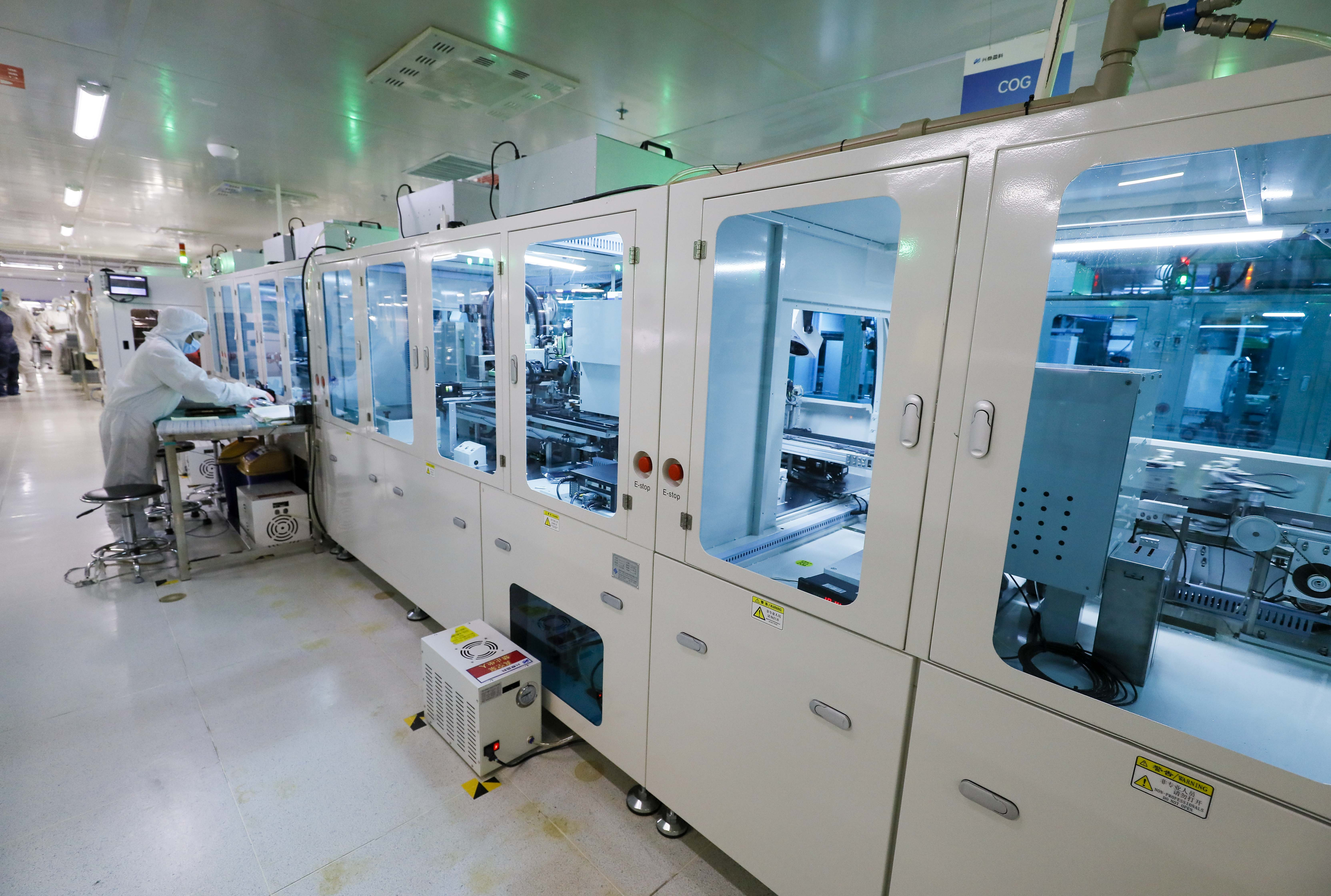
As electronic paper (ePaper) moves from niche applications into large-scale commercial deployment, its manufacturing process and level of automation have become critical indicators of industry maturity. Unlike traditional display technologies, ePaper display module production emphasizes precision bonding, material compatibility, and ultra-low defect rates rather than backlighting or liquid crystal filling. Over the past decade, the ePaper industry has undergone a clear transition—from labor-intensive assembly to highly automated, information-driven production lines—laying the foundation for stable quality, higher output, and lower manufacturing costs.
Core Manufacturing Processes of ePaper Display Modules
The production of an ePaper display module is centered on bonding and integration. The primary task is to precisely laminate the ePaper front plane laminate (FPL) with the TFT backplane, followed by the bonding of the driver chip and flexible printed circuit (FPC). This process relies heavily on specialized adhesives, insulating materials, and conductive bonding agents to ensure both electrical reliability and optical performance.
A typical ePaper display module manufacturing workflow includes multiple tightly controlled steps. These begin with testing, cutting, and cleaning of the ePaper film or master roll, as well as the cutting and cleaning of the TFT backplane. The two substrates are then laminated together with high precision. A PS protective film is bonded onto the ePaper surface to prevent damage during subsequent processing.
Next, the driver IC bonding and FPC bonding steps are carried out, forming the electrical interface of the display module. After that, EC sealing adhesive is applied around the perimeter of the ePaper film to protect the internal structure from moisture and contamination. The final stages include appearance inspection, display image inspection, OTP programming, and other functional tests before the module proceeds to packaging.
Each step directly affects yield and long-term reliability, which is why process consistency and automation are especially important in ePaper manufacturing.
Formation of Automated ePaper Production Lines
As these individual processes became standardized, they were gradually integrated into dedicated ePaper display module production lines. Over time, manufacturers have continuously increased the level of automation across the entire workflow. This shift reflects a broader trend seen across the display industry: higher automation corresponds to a more advanced and scalable industrial stage.
Before 2014, most ePaper display module production relied heavily on manual operations, supported by limited semi-automatic equipment. While this approach was sufficient during early-stage market development, it imposed clear constraints on throughput, consistency, and cost control.
Transition From Manual to Automated Manufacturing
Around 2017, the ePaper industry began to enter a phase of systematic automation. Manufacturers started adopting automated laminators, bonding machines, and inspection systems to reduce human variability and improve production efficiency. This transition marked a turning point, enabling ePaper displays to move toward higher-volume applications such as electronic shelf labels, transportation signage, and commercial displays.
From 2018 onward, the maturity of domestic automation equipment accelerated this transformation. Entire production lines were upgraded to near fully automated operation. Hourly output capacity increased significantly, reaching approximately 800 to 900 display modules per hour per line, depending on size and configuration. At the same time, equipment functionality became more sophisticated, supporting higher precision and tighter quality control.
Key Automation Enhancements in Modern ePaper Manufacturing
Modern ePaper production lines incorporate a wide range of advanced automated features. For example, ACF (anisotropic conductive film) attachment detection systems ensure reliable electrical connections during lamination. Pre-press visual alignment systems improve bonding accuracy between the ePaper film and TFT backplane, reducing pixel defects and alignment errors.
Automation has also been extended to chip handling. Automatic driver IC feeding and flipping mechanisms replace manual placement, improving speed and consistency while minimizing contamination risks. These enhancements significantly reduce defect rates and support long-term process stability.
Intelligent Inspection and Quality Control
After 2019, automation expanded further into intelligent inspection and testing. Dedicated equipment for bonding particle detection and dispensing AOI (automated optical inspection) was introduced, allowing manufacturers to identify microscopic defects that are difficult to detect manually.
Fully automated OTP programming systems, along with automated display image inspection and appearance inspection equipment, became standard in advanced production lines. These systems ensure that each display module meets functional and visual quality requirements before shipment. In addition, fully automated packaging equipment was integrated, completing the end-to-end automation of the manufacturing process.
The Role of Automation in Cost and Quality Optimization
The move toward full automation has had a profound impact on both cost structure and product reliability. Automated production reduces labor dependency, minimizes human error, and enables consistent process control across large volumes. For ePaper displays—where even minor defects can affect visual uniformity or long-term stability—this consistency is essential.
Higher automation levels also improve traceability. Manufacturing data can be collected and analyzed in real time, supporting continuous process optimization and faster root-cause analysis when issues arise. This data-driven approach aligns ePaper manufacturing with broader trends in smart manufacturing and Industry 4.0.
Automation as a Catalyst for Market Expansion
Without automation, the large-scale adoption of ePaper in retail, transportation, and public information systems would not be economically viable. Automated manufacturing has made it possible to produce ePaper display modules at competitive costs while maintaining high quality standards. This, in turn, has accelerated adoption across global markets and diversified application scenarios.
As ePaper technology continues to evolve—especially in areas such as full-color displays and large-format signage—manufacturing automation will remain a key enabler of innovation and scalability.
The Future of ePaper Manufacturing
Looking ahead, ePaper manufacturing is expected to further integrate digital management systems, predictive maintenance, and AI-based quality inspection. These advancements will push yields higher, reduce downtime, and support even more complex display structures. The steady progression from manual assembly to fully automated production reflects the ePaper industry’s transition from emerging technology to a mature display category.
SEEKINK is an ePaper manufacturer that benefits directly from the industry’s advances in automated manufacturing. By leveraging mature, highly automated production lines, SEEKINK delivers reliable, high-quality ePaper display products for commercial applications. One representative product is the ePaper display module (EPD), designed for long-term operation in professional signage environments. Through close collaboration with manufacturing partners and a focus on quality consistency, SEEKINK brings industrial-grade ePaper technology to real-world digital display solutions.
