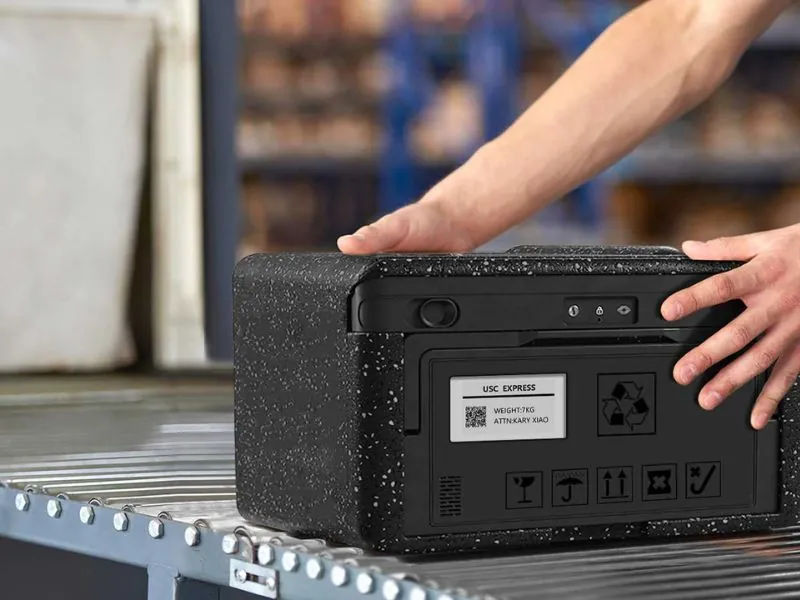
As industrial digitalization accelerates, smart industry has become a core pillar of modern economic transformation. Beyond established ePaper applications such as electronic shelf labels, eReaders, and handwriting notebooks, deep integration with the Industrial Internet is opening up a vast new growth space for the electronic paper industry. With its ultra-low power consumption, wireless connectivity, and excellent outdoor readability, ePaper is increasingly positioned as a key human–machine interaction (HMI) solution within industrial environments.
Industrial Internet Growth Creates New Opportunities for ePaper
The rapid development of digital technologies has made the Industrial Internet a critical engine for industrial upgrading. In China, 2023 marked a year of substantial progress in Industrial Internet construction, accelerating intelligent transformation across traditional manufacturing sectors while enabling the growth of emerging industries. Entering 2024, the pace of high-quality development and large-scale application has further increased.
According to the latest data from the Ministry of Industry and Information Technology, the core Industrial Internet industry reached a scale of RMB 1.53 trillion in 2024. As infrastructure matures, application scenarios deepen, and the industrial ecosystem becomes more integrated, new requirements are emerging for efficient, reliable, and scalable information display at the factory level.
In this context, ePaper’s unique characteristics—ultra-low energy consumption, wireless networking and power supply, and clear visibility in complex industrial environments—make it a strong candidate for next-generation industrial HMI solutions.
Why Human–Machine Interaction Still Matters in Smart Factories
While “lights-out” unmanned factories represent the ultimate vision of automation, the reality is that most intelligent manufacturing processes still rely heavily on human participation. Operators, technicians, logistics personnel, and quality inspectors remain essential to daily production activities.
As long as humans are involved, information exchange between people and machines is unavoidable, and paper-based materials such as work instructions, process cards, labels, and signage continue to play a major role. The challenge for smart industry is how to achieve process digitalization and paperless production without compromising clarity, reliability, or usability.
This is where ePaper offers a practical solution. Unlike LCD displays, ePaper screens do not require continuous power or complex wiring. With a one-time built-in battery, they can support information display for several years, making them ideal for factory environments where wiring costs, flexibility, and maintenance efficiency are critical concerns.
Key ePaper Application Scenarios in Smart Industry
In industrial settings, ePaper product forms are highly diverse and adaptable. One major category is based on electronic shelf label (ESL) architecture, which connects seamlessly with factory information systems such as MES, WMS, and ERP platforms.
Typical applications include:
Picking labels for warehouse and logistics operations
Shelf labels for materials and components
Turnover box labels for in-process inventory tracking
Information display boards for production status
Electronic work instructions guiding operators on-site
Because the ESL system architecture is already mature, nearly all ESL solution providers have expanded into industrial applications, delivering ePaper-based products tailored for factory use.
Combining ePaper with UWB for Precision Industrial Management
Beyond static information display, ePaper can also be integrated with Ultra-Wideband (UWB) indoor positioning technology to form UWB ePaper tags. This combination enables centimeter-level real-time positioning of production-line workers, mobile pallets, and automated carts within factory environments.
By connecting UWB-enabled ePaper tags to Industrial Internet platforms and production management systems, factories can achieve real-time visibility of personnel and asset movement. This data supports continuous optimization of production workflows, improves safety management, and enhances overall operational efficiency.
Such applications demonstrate that ePaper is not limited to passive display but can act as a data node within intelligent industrial systems, bridging physical operations and digital platforms.
Why ePaper Outperforms LCD in Industrial Environments
Industrial scenarios place unique demands on display technology. Displays must be reliable, energy-efficient, readable under varying lighting conditions, and easy to deploy at scale. In many cases, LCD screens introduce unnecessary complexity due to constant power requirements, heat generation, and wiring constraints.
ePaper, by contrast, excels in industrial environments because:
It consumes power only during content updates, making long-term battery operation feasible
Wireless deployment eliminates complex cabling, reducing installation and reconfiguration costs
Paper-like readability ensures clarity even in bright or harsh lighting conditions
High stability supports continuous operation in demanding industrial settings
These characteristics make ePaper particularly suitable for factories undergoing gradual digital transformation rather than full automation.
From Paperless Production to Sustainable Manufacturing
The adoption of ePaper in smart industry aligns closely with broader goals of sustainable manufacturing. By replacing disposable paper materials with reusable digital displays, factories can significantly reduce paper consumption, minimize waste, and improve data accuracy.
More importantly, ePaper enables real-time synchronization between production data and on-site execution, ensuring that operators always work with the latest instructions and status information. This reduces errors, improves quality consistency, and supports lean manufacturing practices.
As Industrial Internet platforms continue to evolve, the role of ePaper is expected to expand from basic information display to integrated human–machine interfaces supporting data-driven decision-making on the factory floor.
Future Outlook for ePaper in Smart Industry
Looking ahead, ePaper is likely to become a standard interface layer in industrial digital systems. As component costs decline and integration experience accumulates, deployment barriers will continue to decrease. Combined with Industrial Internet platforms, AI analytics, and real-time positioning technologies, ePaper will play an increasingly strategic role in intelligent manufacturing.
Rather than competing with high-performance LCD screens, ePaper complements them by addressing scenarios where low power, flexibility, and reliability are more important than visual dynamism.
SEEKINK: e-Ink Display Solutions for Smart Industry
In smart industrial environments, human–machine interaction still relies on clear, reliable, and energy-efficient information displays. SEEKINK provides e-ink display solutions for industrial where low power consumption and wireless deployment are critical.
By integrating with wireless communication systems, these e-ink display solutions help replace traditional paper-based information carriers, contributing to paperless production and sustainable industrial operations.
