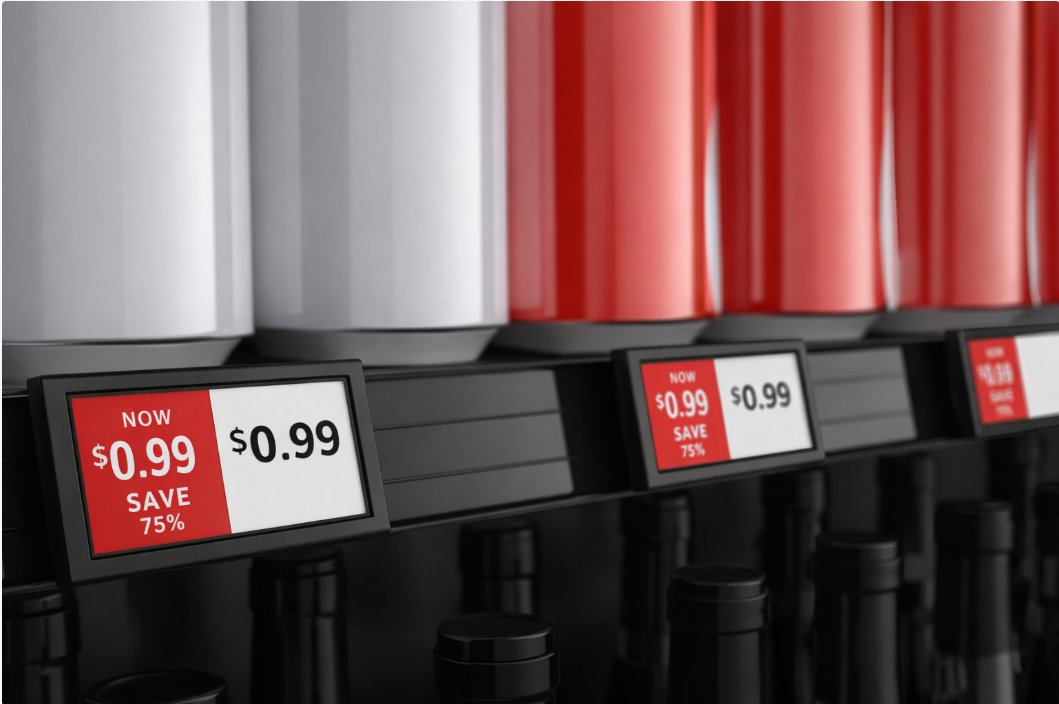
The electronic shelf label (ESL) market has become one of the fastest-growing segments in retail digitalization worldwide. Powered by electronic paper (ePaper) display technology and IoT-based management systems, ESLs are rapidly replacing traditional paper price tags across supermarkets, convenience stores, pharmacies, and large retail chains. Behind this momentum lies a combination of massive market capacity, strong long-term growth trends, and accelerating adoption driven by cost efficiency and operational automation.
The Enormous Market Capacity of ESLs in China
According to data released by China’s National Bureau of Statistics, China had approximately 200,000 chain retail stores in 2023 (excluding pharmaceutical and medical equipment specialty stores). These stores include 45,292 convenience stores, 26,622 supermarkets, 4,523 department stores, and 123,831 other chain retail formats.
When estimated by average SKU (Stock Keeping Unit) volume per store, the resulting demand for electronic shelf labels is substantial. A typical convenience store carries around 1,500 SKUs, supermarkets about 5,000 SKUs, large hypermarkets up to 45,000 SKUs, department stores approximately 50,000 SKUs, and other chain formats around 1,000 SKUs. Since one SKU usually corresponds to one ESL, the total estimated ESL demand across these retail formats reaches approximately 560 million units.
The pharmaceutical retail sector adds even greater scale. According to the Drug Supervision and Administration Statistical Annual Report (2023) issued by China’s National Medical Products Administration, China had 385,600 chain retail pharmacies in 2023. Based on an average of 2,000 SKUs per store, the potential ESL market capacity in pharmacies alone exceeds 770 million units. Together, general retail and pharmaceutical channels make China one of the world’s largest ESL markets in terms of potential volume.
Global ESL Market Capacity: A Multi-Billion-Unit Opportunity
The global ESL market is even larger. Deloitte’s Global Powers of Retailing 2023 highlights leading offline retailers such as Walmart, Schwarz Group, and Walgreens Boots Alliance. These three retail giants operate approximately 40,000 stores worldwide, accounting for about 4.45% of global retail outlets.
Their combined SKU volume exceeds 327 million items, meaning that these three companies alone require over 327 million electronic shelf labels. Based on this proportional analysis, the global ESL market capacity is estimated at approximately 7.27 billion units, underscoring the vast long-term demand potential for electronic paper display technologies in retail environments.
Market Development: From Early Adoption to Rapid Expansion
The modern ESL industry began in 2007, when Swedish company Pricer first introduced ePaper displays into electronic shelf labels in the Japanese market, replacing earlier TN segmented LCD solutions. However, 2015 is widely recognized as the “first year of ESL commercialization,” when global annual shipments exceeded 10 million units.
Following the emergence of the “New Retail” concept in 2016, ESL adoption entered a phase of accelerated growth. Global shipments rose sharply, increasing more than fourfold between 2015 and 2018, surpassing 50 million units. By 2020, shipments exceeded 120 million units, and by 2022, global ESL shipments reached approximately 270 million units.
Transition from Three-Color to Four-Color ESL Technology
Between 2023 and 2024, the ESL industry experienced a major technological transition—from traditional black-white-red (three-color) displays to black-white-red-yellow (four-color) electronic paper modules. By 2024, four-color ESLs accounted for over 60% of market penetration, offering improved visual clarity and stronger promotional capabilities.
However, the transition also introduced short-term challenges. Higher module costs, yield fluctuations, longer delivery cycles, and delayed customer purchasing decisions temporarily constrained shipment growth. As a result, global ESL shipments in 2023 reached approximately 300 million units, slightly below earlier expectations.
Looking ahead, large-scale deployments are driving renewed momentum. In 2023, VusionGroup announced plans to deploy 60 million digital shelf labels across 500 Walmart stores within 12–18 months, helping push 2024 global ESL shipments to around 370 million units. From 2015 to 2024, the ESL market achieved a remarkable compound annual growth rate (CAGR) of approximately 45%.
Market Value and Regional Adoption Trends
Since 2018, the global ESL hardware market has maintained high-speed growth. Market value surpassed USD 800 million in 2020, rose to USD 1.8 billion in 2022, and exceeded USD 2.3 billion in 2023. In 2024, amid the three-color to four-color transition and intensified price competition, growth moderated slightly, with market value reaching approximately USD 2.5 billion. From 2018 to 2024, the industry sustained a strong average CAGR of around 28%.
Regionally, Europe remains the most mature ESL market, led by France, where penetration exceeds 40%, largely driven by the presence of global ESL leader VusionGroup. North America is rapidly expanding, while Japan and South Korea also maintain high adoption rates. Walmart’s leadership continues to influence large-scale ESL rollouts across global supermarket chains.
SEEKINK: Empowering Retail with ESL EPD Modules
As the ESL market evolves toward richer visual performance, SEEKINK provides advanced ePaper modules for electronic shelf labels. Our modules combine ultra-low power consumption with paper-like readability, enabling brands to implement flexible and energy-efficient retail solutions.
As an EPD module manufacturer, we provide e-ink solution to help partners bring electronic shelf label products to market efficiently while maintaining reliability and performance.
