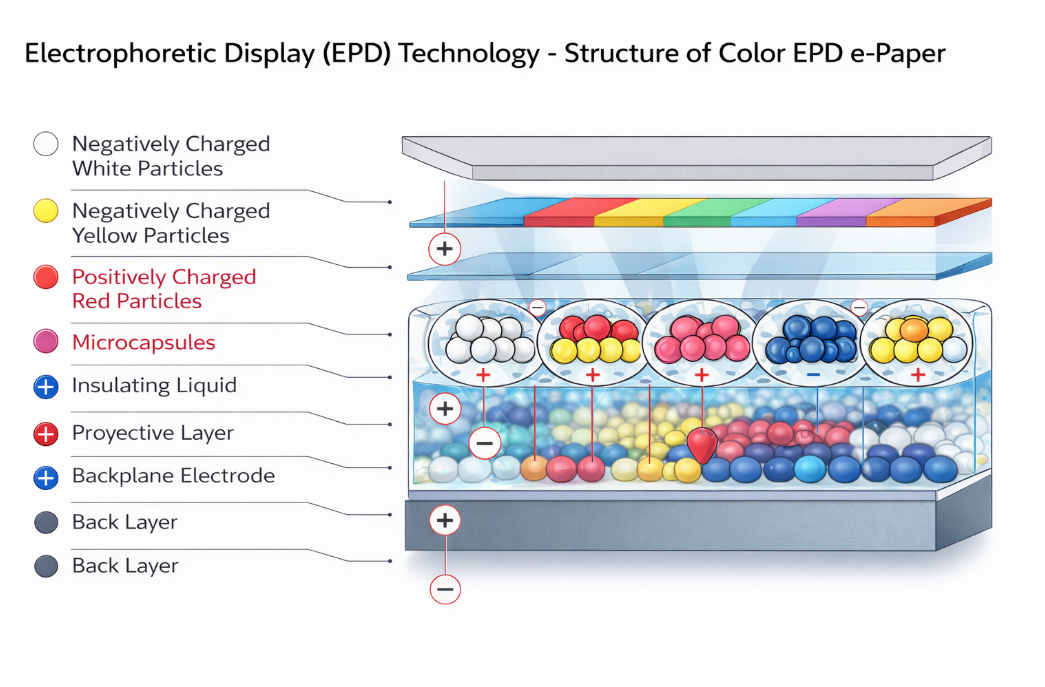
Electrophoretic electronic paper (ePaper) is the most widely adopted ePaper display technology today. Based on the micro-unit structure of the electronic ink film, electrophoretic ePaper can be broadly divided into microcapsule and microcup structures. Although both rely on electrically driven charged particles to form images, their structural design, performance characteristics, and ideal application scenarios differ significantly. Understanding these differences is essential for selecting the right ePaper technology for specific use cases, especially as ePaper expands into transportation, signage, logistics, and smart city infrastructure.
Microcapsule ePaper: Mature, Fast, and Highly Stable
Microcapsule-based electrophoretic ePaper is currently the most mature and widely used structure in the industry. It primarily supports black-and-white display, with grayscale rendering achieved by controlling the movement time of charged black and white particles within each microcapsule.
One of the most notable advantages of microcapsule ePaper is its fast refresh performance. Under room temperature conditions, a 2-grayscale partial refresh can be completed in as little as 125 milliseconds, making it suitable for applications that require relatively frequent updates. In addition, microcapsule ePaper offers excellent display stability and a wide operating temperature range, typically from –15°C to 65°C.
These characteristics make microcapsule ePaper highly reliable in environments with fluctuating temperatures or outdoor exposure.
Color Implementation in Microcapsule ePaper
Although microcapsule ePaper is fundamentally black and white, color can be introduced by adding a color filter layer or color filter array on top of the display. Through this method, microcapsule ePaper can achieve up to 4096 colors.
However, because color is generated through filtering rather than native particle colors, this approach often results in lower color saturation and narrower color gamut compared with other color ePaper technologies. Despite this limitation, filtered-color microcapsule ePaper remains a practical solution for applications that prioritize refresh speed, robustness, and temperature tolerance over vivid color reproduction.
Typical Applications of Microcapsule ePaper
Thanks to its fast refresh speed, high stability, and broad temperature tolerance, microcapsule ePaper is widely used in scenarios such as:
- ePaper tablets and eReaders
- ePaper monitors and desktop displays
- Outdoor ePaper billboards
- Logistics and industrial labels operating in cold environments
In these use cases, reliability and responsiveness are often more critical than color richness.
Microcup ePaper: Designed for Rich Color Display
Microcup ePaper follows the same basic electrophoretic principle as microcapsule ePaper—using electric fields to drive charged particles—but differs fundamentally in its microstructure design.
Instead of encapsulating particles in flexible microcapsules, microcup ePaper divides the electrophoretic fluid into uniform, rigid microcups, each with precisely controlled dimensions. After injecting specific quantities of colored particles into each microcup, the structure is sealed to form the electronic ink film.
By introducing three or four different colored particles into each microcup, manufacturers can create three-color, four-color, five-color, or even full-color ePaper displays without relying on external color filter layers.
Why Microcup Structure Excels at Color Rendering
The microcup structure offers several intrinsic advantages for color ePaper:
First, each microcup acts as an independent display unit, preventing charged particles in adjacent areas from mixing or interfering with one another. This eliminates cross-talk and improves color purity.
Second, the geometric consistency of microcups provides better mechanical stability and structural integrity. This makes microcup ePaper more resistant to deformation and mechanical stress.
Third, because microcup heights are highly uniform, charged particles have more evenly distributed movement space, making it easier to precisely control multiple particle types. This uniformity is critical for stable multi-color rendering.
As a result, microcup ePaper typically delivers higher color saturation, richer color expression, and wider color gamut than color-filter-based microcapsule ePaper.
Comparing Microcapsule and Microcup ePaper
While both technologies fall under electrophoretic ePaper, their strengths differ:
Microcapsule ePaper prioritizes speed, stability, and temperature tolerance
Microcup ePaper prioritizes color richness, structural stability, and display uniformity
Microcapsule ePaper is better suited for environments requiring fast refresh and extreme temperature operation, while microcup ePaper is more suitable for applications where color information density and visual quality are critical.
Choosing the Right Technology for Large-Format Static Information Displays
In many large-format display scenarios, the primary requirement is not frequent content updates, but long-term clarity, color differentiation, and visual stability. Wall-mounted information boards used in public interiors, commercial spaces, and institutional environments often display schedules, announcements, guidance information, or visual content that remains unchanged for hours or even days.
In these cases, refresh speed is less critical than color accuracy, uniformity, and image persistence. Microcup-based color ePaper is particularly well suited to such applications, as it provides richer native color rendering without relying on color filters, while maintaining the inherent advantages of electrophoretic ePaper—non-emissive display, ultra-low power consumption, and excellent readability under ambient light.
Advantages of Microcup Color ePaper in Wall-Mounted Displays
For large wall-mounted displays, consistent color performance across the entire panel is essential. The uniform microcup structure ensures stable particle distribution and minimizes color interference, which is especially important as display size increases. This structural advantage allows microcup ePaper to maintain clear visual hierarchy and legibility even when displaying complex layouts or color-coded information.
Additionally, the ability of microcup ePaper to hold images without continuous power makes it ideal for fixed installations, reducing operational energy consumption and long-term maintenance requirements. These characteristics align well with environments that prioritize sustainability, visual comfort, and reliable information presentation.
Application Example: Large-Format Spectra 6 Color ePaper Display
With the S315E6 Spectra 6 E-ink Wall-mounted Billboard, we demonstrate how microcup color ePaper can be applied to large-format, long-duration display scenarios. This display provides stable color differentiation and high readability over extended periods, making it ideal for wall-mounted information boards in commercial and institutional spaces.
At SEEKINK, we designed this application to prioritize visual comfort, image persistence, and ultra-low power consumption over rapid refresh. It exemplifies how our microcup electrophoretic ePaper technology supports scalable, energy-efficient, and visually reliable large-size electronic paper displays while reinforcing the technical principles discussed throughout this article.
