In the rapidly evolving display industry, electronic paper (ePaper) continues to attract attention due to its ultra-low power consumption, sunlight readability, and paper-like visual experience. Within the ePaper family, multiple technical approaches coexist, including electrophoretic displays (commonly known as E Ink), electrowetting, cholesteric LCD, and Total Internal Reflection (TIR) ePaper.
TIR ePaper represents one emerging technical route that focuses on faster refresh performance and color capability. But how does this TIR technology work, and how does it differ from mainstream electrophoretic ePaper? Understanding these differences helps system designers and product developers make informed technology choices.
How Does Total Internal Reflection ePaper Work?
Total Internal Reflection ePaper is a unique display technology that uses a specialized mechanism based on electrophoretic principles. Similar to electrophoretic displays used in microcapsule ePaper, TIR ePaper relies on a liquid suspension of charged particles, but it is distinct in several ways.
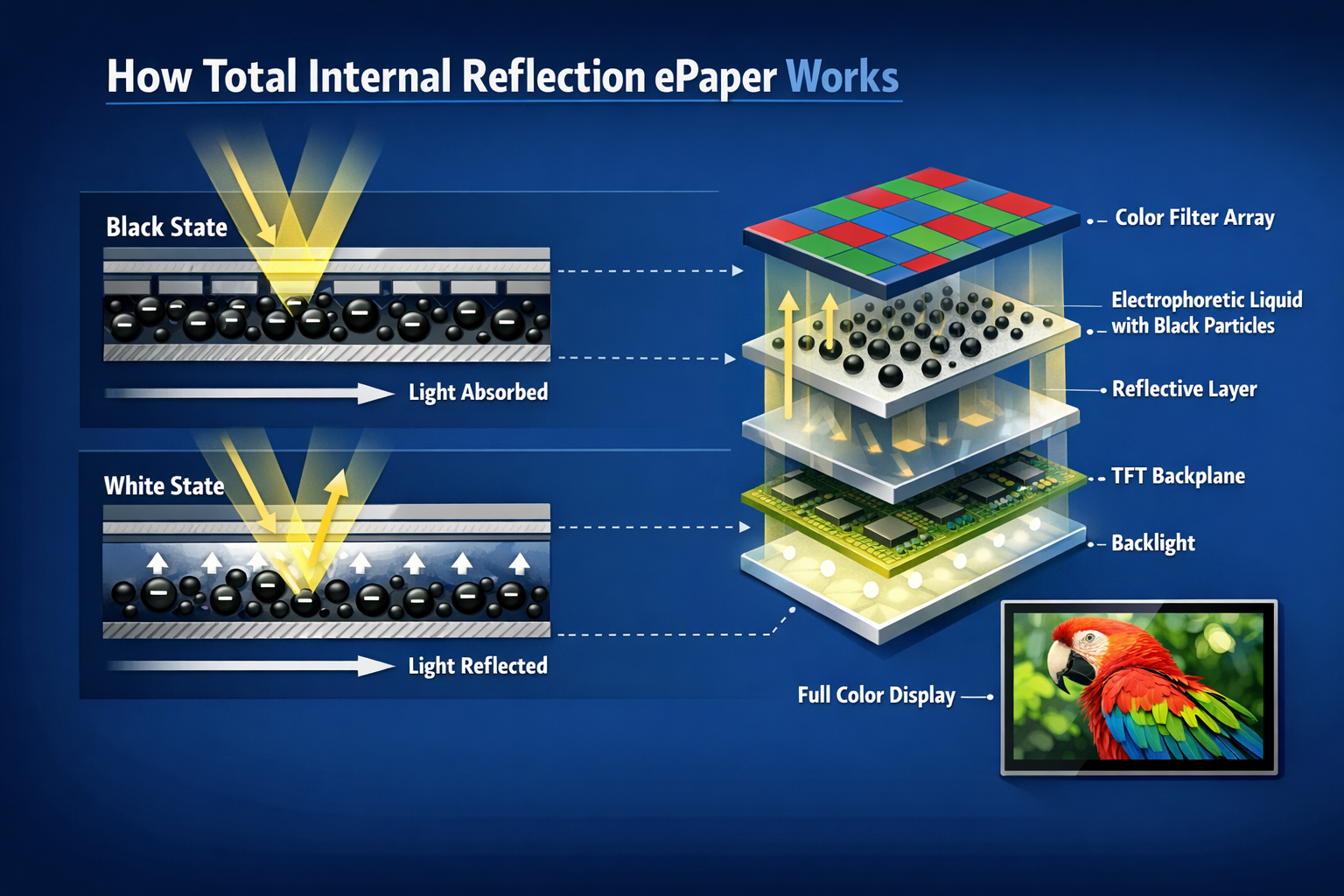
At the heart of this display technology is a total internal reflection mechanism, which functions through a layered structure. The display consists of several key components:
- Color Filter Array: Located at the front of the display, these filters provide the colors needed to display vibrant, dynamic content.
- Reflective Layer: This layer reflects incoming light, contributing to the bright, crisp images seen on the screen.
- TFT Backplane: The thin-film transistor (TFT) backplane controls the electrical signals that guide the movement of particles, enabling the display to form images.
- Electrophoretic Liquid: Unlike other ePaper technologies, TIR ePaper uses only black, light-absorbing charged particles, as opposed to black and white particles. These black particles interact with the light-reflective structures to create the desired image.
The principle behind the display is simple yet effective: when an electric field is applied, the black particles move either toward or away from the optical structure. When the black particles are close to the optical structure, light entering from the outside is absorbed, resulting in a black image. When the particles move away from the structure, the light is reflected back, creating a white image. This switching mechanism provides a high contrast black-and-white display.
What Makes TIR ePaper Different from Traditional E Ink Displays?
The most widely adopted ePaper technology today is electrophoretic E Ink, which uses microcapsules containing black and white charged particles. These particles migrate under electric fields and remain stable without continuous power, enabling true bi-stable image retention.
TIR ePaper differs in several important aspects:
- Particle Structure – Uses primarily black particles instead of dual-particle microcapsules.
- Optical Principle – Relies on total internal reflection rather than direct particle visibility.
- Refresh Performance – Supports faster switching and limited motion display.
- Power Behavior – Requires continuous driving power to maintain images and does not offer full bi-stability.
As a result, TIR ePaper prioritizes dynamic performance, while electrophoretic E Ink prioritizes ultra-low power consumption and long-term image stability.
Benefits and Limitations of TIR ePaper
Key Benefits
- Higher Refresh Rate – Enables smoother transitions and limited video-like content.
- Color Capability – Supports thousands of colors through color filter integration.
- LCD-Compatible Manufacturing – Can leverage existing LCD production infrastructure.
- No Backlight Required – Maintains reflective, eye-friendly viewing.
Limitations
- Not Fully Bi-Stable – Continuous power is needed to hold images.
- Higher System Complexity – Optical structure increases design complexity.
- Limited Commercial Maturity – Supply chain and long-term field data remain relatively limited compared with E Ink.
Conclusion: SEEKINK’s Role in ePaper Technology
Total Internal Reflection ePaper showcases the potential of faster refresh rates and richer color performance, making it promising for dynamic applications such as digital signage and interactive displays.
However, the mainstream ePaper market is still dominated by electrophoretic technology due to its ultra-low power consumption, true bi-stable capability, excellent outdoor readability, and long-term reliability. These advantages make electrophoretic ePaper the preferred choice for large-scale, energy-efficient, and long-life deployments.
At SEEKINK, we focus on delivering high-quality e-ink solutions, supporting partners from concept design to scalable production. While new technologies like TIR continue to expand display possibilities, electrophoretic ePaper remains the most practical and commercially proven solution today.
