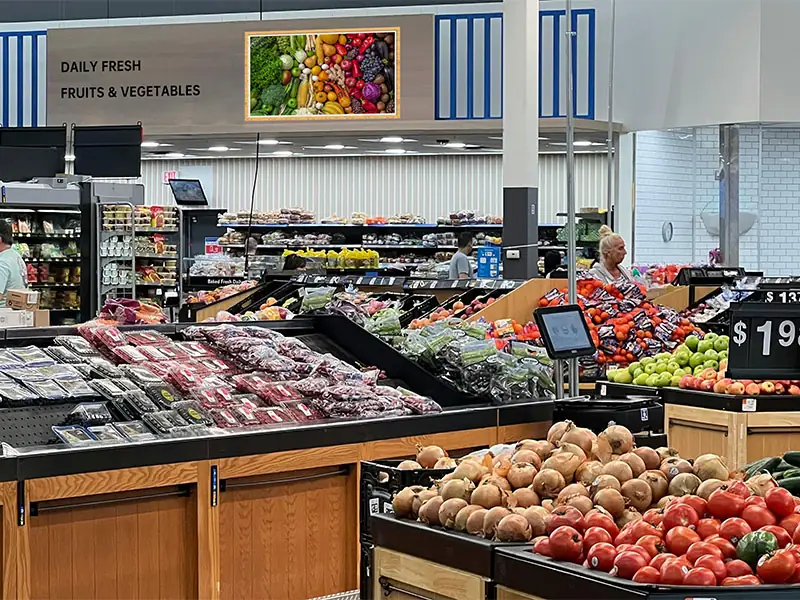
As global retail accelerates toward digital and intelligent operations, the ePaper new retail market, led by Electronic Shelf Label (ESL) systems, has become one of the most successful large-scale applications of ePaper technology. By combining ultra-low power displays with IoT connectivity and cloud management, ePaper ESL systems are fundamentally reshaping how retailers manage pricing, promotions, and in-store information.
What Is an ePaper ESL System?
An Electronic Shelf Label (ESL) system is a typical IoT architecture composed of three core components: ESL terminals installed on shelves, base stations or gateways, and a cloud-based management platform.
Together, these elements form a closed-loop system that allows retailers to centrally manage and wirelessly update pricing and product information across thousands of labels in real time. Compared with traditional paper labels, ESL systems dramatically reduce labor costs, eliminate pricing errors, and enable fast, unified price adjustments across chain stores.
ESL Terminals: Why ePaper Replaced LCD
ESL terminals—also known as electronic price tags or electronic shelf labels—are display devices placed directly on store shelves. Historically, ESLs existed in two main forms: LCD-based ESLs and ePaper-based ESLs. Although both aim to digitize shelf pricing, their technical characteristics and long-term suitability differ significantly.
LCD ESLs require continuous power to maintain display content. This leads to higher energy consumption, complex wiring requirements, and increased installation and maintenance costs. Segment-style LCD ESLs have largely exited the market, while matrix-style LCD ESLs are mainly limited to large-format scenarios due to wiring complexity and potential electrical safety concerns.
In contrast, ePaper ESLs display content without consuming power once an image is refreshed. They require no external wiring and are typically powered by small coin-cell batteries. Thanks to this fundamental advantage, ePaper ESLs have become the preferred solution for retail digitalization, widely deployed in supermarkets, convenience stores, pharmacies, electronics shops, fresh food markets, and other shelf-based retail environments where prices change frequently.
Ultra-Low Power Design Enables Long Service Life
A typical ePaper ESL terminal is built around a low-power MCU integrated with a wireless communication module. Powered by coin-cell batteries, the ESL drives an ePaper display module to update content when needed. Most ESLs run on an RTOS (real-time operating system) optimized for low energy consumption.
To maximize battery life, ESL vendors usually develop private communication protocols between labels and gateways. These protocols reduce data transmission overhead and minimize active radio time. Common wireless bands include Bluetooth, 2.4 GHz, and 433 MHz, with 2.4 GHz currently being the mainstream choice due to its balance of bandwidth, range, and ecosystem maturity.
Battery performance illustrates the advantage of ePaper ESLs clearly. A standard 2.13-inch ePaper ESL powered by two CR2450 coin cells (approximately 1200 mAh total capacity) can support 3–5 price updates per day while achieving a battery life of 7–10 years. Leading vendors have already reached or exceeded 10 years of service life. Some manufacturers further optimize internal space by using custom single-use lithium manganese pouch batteries, extending ESL lifespan to up to 15 years.
Chip Ecosystem and Communication Standards
From a chip perspective, ESL systems benefit from a relatively mature wireless MCU ecosystem. Bluetooth and 2.4 GHz chip suppliers are abundant, and pricing—especially from Chinese mainland vendors—is highly competitive. As a result, most ESL system integrators in China prefer domestic chips, enabling cost-effective large-scale deployments.
In 2022, the Bluetooth SIG released Bluetooth 5.4, introducing a standardized ESL profile. This version simplifies the Bluetooth protocol stack and includes optimizations specifically designed for ESL applications. The release of Bluetooth 5.4 marked an important milestone, signaling that the ESL market had gained strong recognition from the global technology ecosystem and entered a phase of more standardized, long-term development.
Despite this, many leading ESL system integrators still rely on custom private protocols between labels and gateways. These proprietary solutions allow vendors to further reduce power consumption, lower BOM costs, and improve system efficiency. Overseas ESL providers have traditionally favored chips from companies such as TI and ST, which contributes to higher overall system costs. Since 2023, however, increasing cost pressure has driven many international ESL vendors to adopt Chinese mainland chips in their product upgrades.
Why ESL Is the Flagship Application of ePaper
Among all ePaper applications, ESL stands out due to its unique combination of mass deployment scale, high update frequency, and extreme power efficiency requirements. Few other display scenarios demand millions of small displays operating continuously for a decade on battery power. ePaper’s bistable nature—consuming energy only when refreshing—makes it uniquely suitable for this role.
Beyond pricing, modern ESL systems increasingly support QR codes, inventory indicators, promotional icons, and even integration with AI-driven pricing engines. This transforms ESLs from simple price tags into intelligent retail terminals, forming the visual foundation of smart stores.
The Broader Role of ePaper in New Retail
While ESLs dominate shelf-level applications, the new retail ecosystem also requires larger-format digital signage for wayfinding, promotions, and information display. In these scenarios, ePaper’s advantages—low power consumption, excellent readability under ambient light, and minimal maintenance—remain highly relevant, especially where continuous backlighting is unnecessary.
SEEKINK delivers practical ePaper display solutions with a focus on our shelf-level strategic brand partners’s B2B business based on our ePaper display module (EPD module) manufacturing. In addition to supporting large-format signage, the company offers Electronic Shelf Label (ESL) module solutions designed for supermarkets, convenience stores, pharmacies, and other retail environments. SEEKINK’s ESL modules integrate ultra-low power ePaper displays with wireless connectivity and cloud-based management platforms, enabling centralized, real-time updates of pricing, promotions, and product information. By leveraging ePaper’s bistable, energy-efficient properties, these ESL modules allow retailers to reduce labor costs, minimize errors, and maintain sustainable, always-on digital shelf labeling—making them the core technology driving intelligent retail digitalization.
