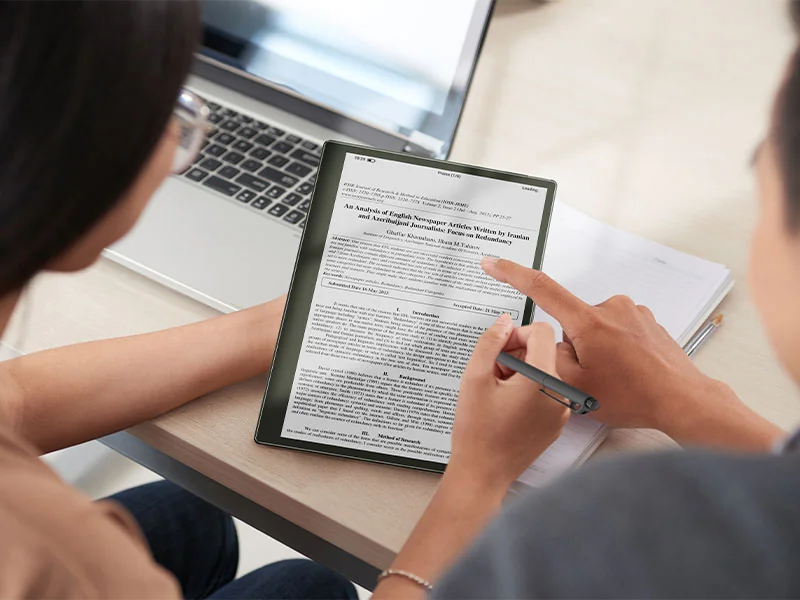
As education systems worldwide accelerate toward digital transformation, smart education has emerged as a critical application area for ePaper technology. Unlike traditional LCD-based learning devices, ePaper offers a non-emissive, eye-friendly, and low-power display, making it uniquely suited for long-term academic use. In recent years, ePaper has evolved from a supplementary tool into a core infrastructure component in both school-based education systems and consumer-oriented learning devices.
ePaper in Smart Education: Two Core Application Models
The application of ePaper in smart education is mainly reflected in two directions:
School-oriented ePaper homework notebook systems (2B) and consumer-oriented educational practice tablets (2C).
Both models are built upon ePaper handwriting tablet hardware, but they differ significantly in system design, user groups, and deployment logic.
School-Based ePaper Homework Notebook Systems
The ePaper homework notebook system is designed for institutional use in schools. It typically consists of two major components:
- ePaper smart learning terminals (student devices)
- Cloud-based education management platforms
The terminal itself is an Android-based smart device that replaces traditional LCD screens with ePaper displays, supporting handwriting input and wireless connectivity via Wi-Fi, 4G, or 5G. On top of the Android system, customized applications are developed specifically for homework submission, practice, and review. Once deployed, the device becomes a dedicated learning terminal, rather than a general-purpose tablet.
The cloud platform usually includes functions such as:
- Question banks and worksheet generation
- Assignment distribution and submission
- Automated grading for objective questions
- Learning data aggregation and analytics
More importantly, these platforms can perform AI-based analysis on students’ daily homework data, generating multi-dimensional reports for teachers, parents, schools, and education authorities.
Why ePaper Is a Rigid Demand in Smart Education
From the perspective of Education Informatization 2.0, the goal is not just digital tools, but data-driven personalized education. Building a continuous knowledge graph for each student—rather than relying on fragmented paper homework and periodic exams—is a foundational requirement.
Traditional paper-based homework produces discrete and subjective records. In contrast, ePaper homework notebooks enable continuous, quantifiable data collection, capturing how students write, how long they spend on tasks, and where they repeatedly make mistakes. This data becomes the basis for personalized teaching strategies.
However, using LCD-based devices for prolonged daily homework conflicts directly with national youth vision protection policies. Long-term exposure to backlit screens raises concerns about eye strain and myopia. In this context, ePaper’s non-emissive, paper-like display becomes not just an advantage, but a necessity.
If electronic homework devices are indispensable data-collection tools in smart education, then ePaper displays are the only display technology that aligns with both educational goals and health policies.
Environmental and Sustainability Benefits
Beyond pedagogy and health, ePaper also delivers significant environmental benefits. In K12 education, homework and practice materials consume massive amounts of paper every year. According to modeling estimates by CCID Consulting based on 180 million K12 students, widespread adoption of ePaper homework notebooks could reduce carbon emissions by over 2 million tons of CO₂ equivalent.
This directly supports national strategies around carbon reduction, sustainability, and green education, making ePaper a strategic technology rather than a short-term product trend.
From 2B Challenges to 2C Breakthroughs
Despite strong theoretical advantages, the 2B education market faced setbacks after regulatory changes in the K12 tutoring sector. Platforms such as Tencent Classroom shut down or transformed their strategies, slowing institutional adoption of ePaper homework systems.
However, the industry quickly found a new growth path in the 2C consumer education market.
Starting in 2021, leading online education companies leveraged their existing content resources and repositioned ePaper devices as consumer-facing educational products.
Rapid Growth of Consumer Education ePaper Tablets
By 2023, consumer-oriented ePaper education tablets received strong market feedback. In 2024, this segment experienced a clear breakout:
Multiple brands including Yuanfudao, Zuoyebang, and Wusan Education launched 2C education tablets.
Annual sales of 2C education ePaper tablets exceeded 700,000 units.
This segment accounted for approximately 24% of the entire ePaper handwriting tablet market.
These products focus on daily practice, handwriting exercises, and AI-assisted learning, making them highly relevant for families seeking effective yet eye-safe learning tools.
The Long-Term Outlook for ePaper in Education
Looking ahead, ePaper’s role in education is expected to deepen rather than fade. Its unique combination of health protection, data continuity, sustainability, and intelligent analytics positions it as a long-term infrastructure technology for smart education—not just a hardware choice.
As education systems increasingly rely on learning data, AI analysis, and personalized instruction, ePaper-based devices will remain central to this evolution.
SEEKINK: Powering Smart Education with ePaper Technology
SEEKINK is a leading innovator in the ePaper industry, providing advanced hardware solutions for smart education, smart retail, and industrial applications. Its H103NPL e-Ink Tablet is designed as a high-performance ePaper handwriting device, well-suited for both educational institutions and consumer learning scenarios.
With deep expertise in ePaper display technology and system integration, SEEKINK supports education partners in building eye-friendly, data-driven, and sustainable learning solutions.
