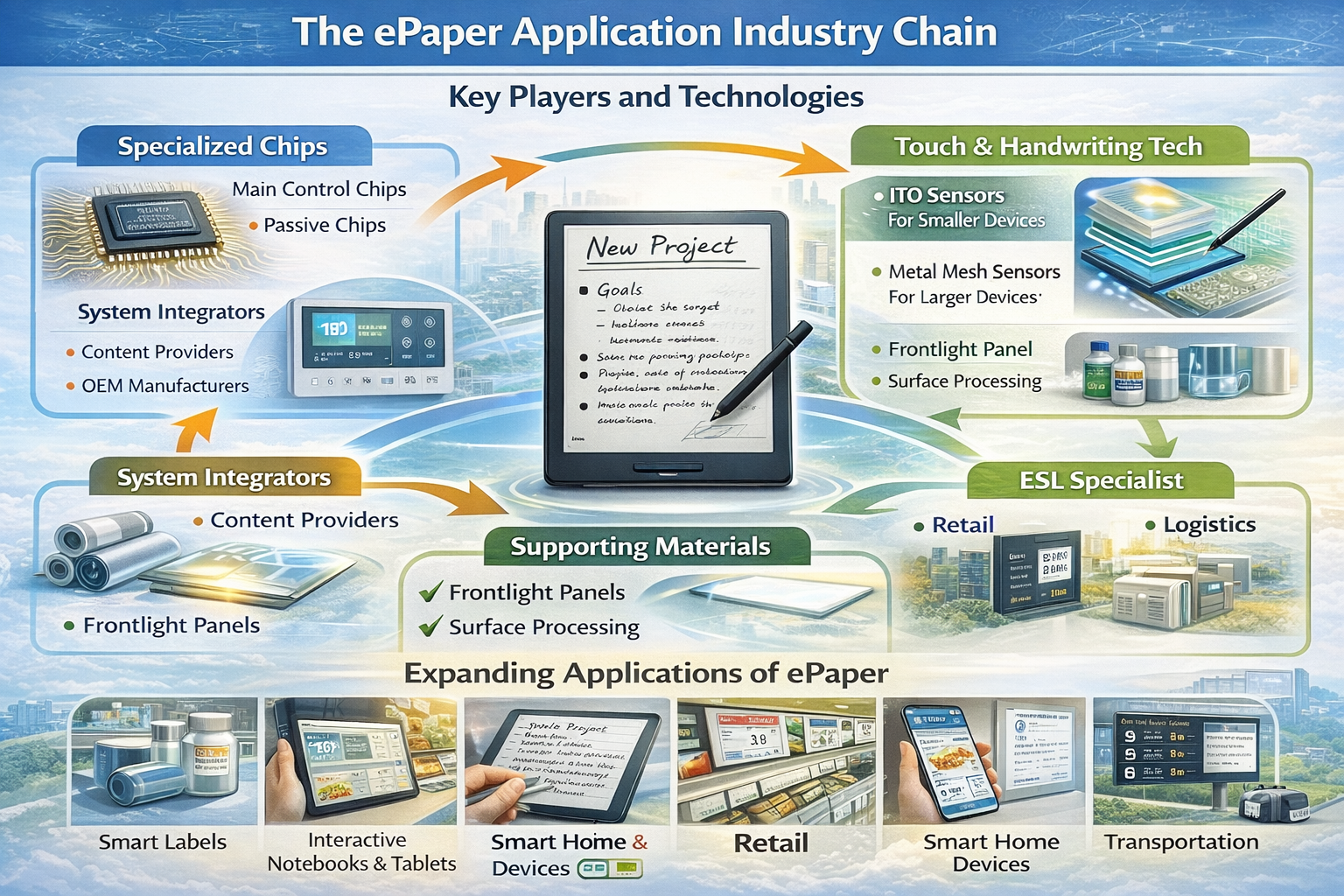
The ePaper industry has grown exponentially in recent years, driven by advancements in flexible display technologies, low power consumption, and the increasing demand for digital solutions across various sectors. ePaper technology, once primarily associated with e-readers, has evolved into a versatile tool used in a wide range of applications, from smart labels to interactive notebooks and smart home devices. This growth can be attributed to its ability to replace traditional paper, providing a more sustainable and efficient alternative. This article will explore the key components of the ePaper application industry chain, including essential technologies such as specialized chips, touch technology, handwriting technology, frontlight panels, and surface processing.
The ePaper Application Industry Chain: Key Players and Technologies
The ePaper application industry is composed of multiple stakeholders and technologies, each playing a critical role in enabling the widespread use of ePaper-based products. From system integrators to content providers and OEM manufacturers, the ecosystem spans across different markets, including consumer electronics and industrial applications.
- Specialized Chips for ePaper Devices
As a unique display technology, ePaper requires specialized chips to manage the display’s performance. These chips can be categorized into two main types: main control chips and passive chips. Specialized chips are crucial for managing the display and controlling functions such as refresh rates, color depth, and power consumption.
For example, in e-paper notebooks, particularly those using electrophoretic microcapsule technology, high resolution and quick refresh speeds are essential. These devices may require a timing controller chip (Tcon) to manage the display’s operations. Some advanced devices integrate the Tcon into the system-on-chip (SoC) to simplify the design.
Moreover, power management integrated circuits (PMICs) are essential in high-resolution ePaper displays, ensuring efficient voltage regulation with outputs such as ±15V, ±20V, and -5V to 0V. In the case of electronic price tags, custom chips have been developed to optimize energy efficiency, such as the 2.4GHz Bluetooth chips specifically designed for low power consumption.
- Touch Technology for ePaper Tablets
As ePaper devices evolve, the demand for touch capabilities has increased, especially in larger ePaper tablets and e-notebooks. There are two main types of touch technologies used in ePaper devices: ITO (Indium Tin Oxide) and Metal Mesh.
For smaller devices, such as e-readers under 10 inches, ITO technology remains dominant due to its cost-effectiveness and adequate performance for basic touch functions. However, as the screen size increases (above 10 inches), Metal Mesh technology is becoming more common.
The Metal Mesh technology has gained popularity for larger devices due to its superior performance in larger formats. It offers lower impedance and improved touch accuracy compared to ITO, which can be a limiting factor in larger screens. There are two approaches to producing Metal Mesh: additive processes and subtractive processes. The additive process, which uses chemical plating, has grown rapidly in recent years and offers advantages in material usage, adhesion strength, and environmental friendliness. It is also capable of achieving precision as low as 2 microns, making it ideal for larger ePaper tablets.
- Handwriting Technology
One of the most exciting innovations in the ePaper application industry is the integration of handwriting technology. This is particularly relevant in the growing market for ePaper-based notebooks and digital note-taking devices. These devices replicate the feeling of writing on paper while offering the benefits of digital content management.
ePaper notebooks use electrophoretic technology to enable high-definition writing and drawing. By combining low power consumption with a paper-like experience, ePaper notebooks provide users with an eco-friendly alternative to traditional notebooks, while offering features such as easy editing, syncing across devices, and storage of vast amounts of content.
- Frontlight Panels and Surface Treatment
For ePaper displays to be effective in various lighting conditions, frontlight panels and surface processing technologies are used to improve readability. Since ePaper technology is reflective, it relies on ambient light for visibility. However, for use in low-light environments, frontlight panels are essential. These panels provide just enough light to illuminate the screen without requiring power-hungry backlighting, which is typical in LCD screens.
In addition, surface processing ensures that ePaper devices are durable and resistant to wear and tear. Optical adhesives and protective coatings are applied to enhance touch sensitivity and resilience against scratches, improving the overall user experience.
The Expanding Applications of ePaper
The versatility of ePaper technology has led to its adoption across a variety of industries, with applications ranging from smart home devices to retail and logistics. The retail sector, in particular, has benefited from the integration of ePaper in price tags and electronic shelf labels (ESL), enabling stores to update pricing and promotions remotely, reducing the need for manual labor and improving inventory management.
In the healthcare industry, ePaper is being used in bedside cards for patients, allowing medical staff to quickly access patient information while reducing paper waste. In addition, ePaper has found applications in retail signage, smart packaging, and wearable devices, all of which benefit from its ultra-low power consumption, high readability, and versatility in diverse lighting conditions.
As ePaper technology continues to evolve, its potential for transforming industries grows, offering sustainable and innovative solutions for digital signage, smart packaging, wearables, and more.
SEEKINK: Innovating with ePaper Solutions
At the forefront of ePaper innovation is SEEKINK, a company committed to providing high-quality ePaper solutions that span a wide range of applications. One representative example is our T073E6HD Full‑Color Wireless E‑Ink Nameplate, an elegant and ultra‑low‑power display designed for conference, meeting, and reception environments. Featuring a 7.3‑inch full‑color EPD and built‑in Bluetooth connectivity, this wireless e‑paper nameplate delivers clear participant names, titles, and meeting details while operating without wiring, supporting efficient and organized communications.
SEEKINK’s expertise in ePaper technology, from display modules to customized solutions, positions it as a leader in the growing ePaper market. Whether you are looking for e-readers, smart labels, or interactive displays, SEEKINK provides innovative and sustainable solutions for a wide range of industries.
