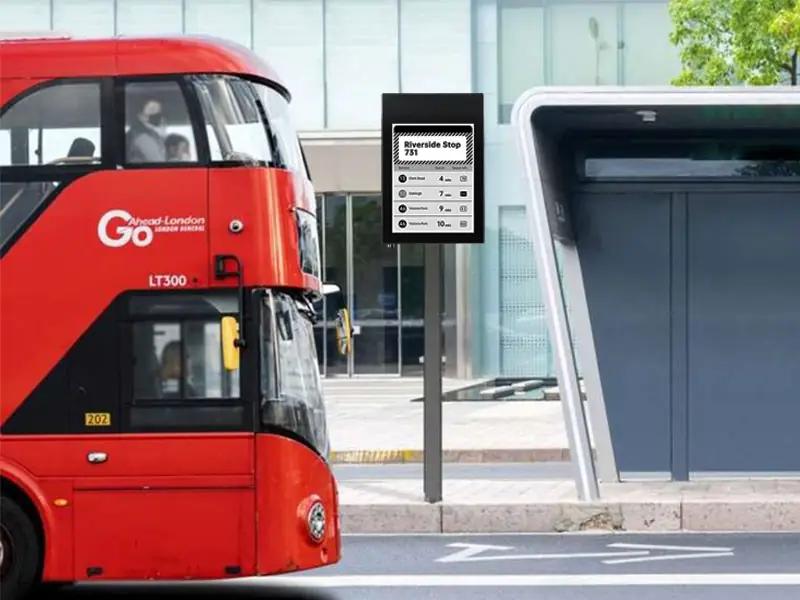
As cities worldwide accelerate the development of smart transportation systems, real-time information delivery has become a critical component of public mobility. Passengers increasingly expect accurate arrival data, route updates, and service notices at transit stops. However, in many urban and suburban areas, especially outside city centers, power supply limitations remain a major barrier to information digitization. In this context, electronic paper (ePaper) has emerged as a highly practical solution, enabling low-power, solar-enabled public transportation signage that supports smart city development.
Why Smart Transportation Needs Low-Power Display Solutions
Traditional digital bus stop displays are typically based on LCD or LED technology. While capable of dynamic content, these displays require continuous power, stable wiring, and frequent maintenance. As a result, they are usually limited to central urban areas with complete electrical infrastructure.
In contrast, a significant number of bus stops—particularly in non-core urban districts—lack access to grid power. These locations still rely on static printed timetables, which are costly to update and cannot reflect real-time service changes. To achieve comprehensive transportation informatization, cities need display systems that can operate independently of fixed power sources.
This is where ePaper plays a decisive role. As a reflective display technology, ePaper consumes power only when refreshing content and requires no electricity to maintain static images. This characteristic makes it ideally suited for outdoor transportation signage powered by solar energy or battery systems.
Solar-Powered ePaper Bus Stop Signage Systems
The most representative application of ePaper in smart transportation is the solar-powered electronic bus stop signage system. These systems typically use a 31.2-inch black-and-white ePaper display module as the core display unit. Combined with a solar power generation system and energy storage, the signage can operate autonomously for extended periods.
Through 4G LTE Cat.1 connectivity, the ePaper bus stop signage connects to cloud-based public transportation data servers. Real-time bus arrival information, route updates, and service notifications are retrieved and displayed clearly on the ePaper screen. This enables passengers to access accurate arrival data even at stops without access to grid electricity.
Because ePaper offers excellent readability under direct sunlight and wide viewing angles, it performs particularly well in outdoor environments. Unlike backlit screens, it remains legible without glare, enhancing user experience in all lighting conditions.
ePaper Bus Stop Poles as a Complementary Solution
In addition to standard bus stop signage, ePaper bus stop poles serve as an important complementary solution. These are typically constructed using two 13.3-inch black-and-white ePaper display modules, combined into a vertical signage format.
Bus stop poles are designed for areas where full bus shelters are not available, which is common in non-central or low-density districts. When paired with solar power systems or standalone battery solutions, ePaper bus stop poles provide the same real-time information functions as larger bus stop signage, including route numbers, arrival times, and service notices.
This flexible form factor allows cities to extend smart transportation coverage to locations previously excluded due to infrastructure constraints, supporting more inclusive public service delivery.
Market Scale and Deployment Potential
According to industry statistics from ePaper Insight, the total number of bus stops and bus stop poles in China is estimated at approximately 800,000 units. This figure highlights the enormous potential market for low-power digital signage in public transportation.
A significant portion of these stops are located outside city centers and lack permanent electrical connections. For these locations, ePaper-based solutions offer a realistic and scalable path toward informatization. Instead of selective deployment limited to high-profile areas, cities can implement uniform, citywide real-time information systems by adopting solar-powered ePaper signage.
Operational Advantages of ePaper in Transportation Scenarios
The advantages of ePaper in smart transportation extend beyond power efficiency:
Ultra-low operating costs
Solar-powered operation and minimal energy consumption significantly reduce long-term maintenance expenses.
High reliability
Fewer electronic components and no continuous backlight reduce failure rates in outdoor environments.
Excellent visibility
Paper-like displays ensure readability in bright sunlight and varied weather conditions.
Simplified installation
Wireless connectivity and self-powered systems eliminate the need for complex wiring and civil engineering work.
These characteristics make ePaper particularly suitable for large-scale deployment in public infrastructure projects, where cost control and reliability are critical.
Why ePaper Fits Public Transportation Better Than LCD
Public transportation signage primarily displays static or semi-static information that updates at intervals rather than continuously. This usage pattern aligns perfectly with ePaper technology. Unlike LCD displays, which are designed for video playback and continuous illumination, ePaper excels at presenting text and graphics with minimal energy consumption.
Additionally, ePaper’s non-emissive nature improves passenger comfort, especially at night, as it avoids excessive brightness that can cause light pollution or visual discomfort.
Future Outlook for ePaper in Smart Transportation
As smart city initiatives expand, ePaper is expected to play an increasingly important role in transportation informatization, especially in areas where power infrastructure is incomplete or costly to deploy. With ongoing improvements in wireless connectivity, solar efficiency, and cloud integration, ePaper-based transportation signage is poised to become a standard component of future public transit systems.
By enabling real-time information access without dependence on grid power, ePaper supports more equitable and sustainable urban mobility.
SEEKINK and Its Smart Transportation ePaper Solutions
SEEKINK delivers reliable solutions for large-scale public infrastructure deployment. S133EC-O 13.3-inch E-Paper Bus Stop Signage, designed specifically for outdoor transportation scenarios. Featuring excellent sunlight readability, ultra-low power consumption, and compatibility with solar power systems, it enables real-time bus information display in locations without grid electricity.
